Attitudes towards attempted suicide: the development of a measurement tool
Ouzouni Christina
Lecturer in Nursing, Department of Nursing, Technological Institute of Lamia
- *Corresponding Author:
- Ouzouni Christina
Department of Nursing
Technological Educational Institute of Lamia
3rd Km Old National Road, Lamia-Athens
35100 Lamia, Greece
Tel: + 30 22310 60352
Mob: + 6977379125
E-mail: christinaouzouni@yahoo.com
Abstract
Background: Nowadays reported global suicide attempt rates have increased dramatically and there is some evidence that failure by health care professionals to recognize and respond to the needs of a suicidal person may be a factor in the repeated suicide attempts of some people. Moreover, research evidence has indicated that unfavorable attitudes among doctors and nurses exist towards attempted suicide patients, which have a negative impact upon the quality of care they receive. The aim of the study was to develop, pilot and validate a measure of attitudes towards patients who have attempted suicide. Method and Material: A questionnaire comprising 102 items was constructed from a existing validated instrument in combination with findings from a literature review. A pilot study was carried out with a sample of 40 (n=40) doctors and nurses, to assess the feasibility and acceptability of the instrument developed. Questionnaires were then distributed to a sample of 186 (n=186) doctors and nurses, working in two general hospitals in Athens area. In order to establish the scale’s construct validity a factor analysis was performed. In addition, a face validity of the measurement tool was assessed by a group of experts. Reliability of the questionnaire was assesses by test - retest. Results: Preliminary analysis reduced the 102 items of the questionnaire to 80. The following eight factors were retained: “positiveness”, “acceptability”, “religiosity”, “professional role and care”, “manipulation”, “personality traits”, “mental illness”, “discrimination”. The 8 factors yielded accounted for the 55.45% level of the total variance. The resultant “Attitudes Towards Attempted Suicide-Questionnaire (ATAS-Q) achieved high internal consistency, with Cronbach’s alpha of 0.96 (a=0.96) in test and a=0.97 in retest assessment. Conclusions: The construction, development and validation of the ATAS-Q will provide a useful measurement tool, enabling health care professionals to enhance their understanding of their attitudes towards patients who attempt suicide in order to enhance the provision of effective care to them.
Keywords
attitudes, attempted suicide, parasuicide, doctors, nursing staff
Introduction
Suicide is one of the commonest causes of non-disease related death and it is a major public health problem worldwide [1,2]. Both fatal and non-fatal suicide behaviors constitute a considerable problem in terms of individual suffering as well as the burden on health care and costs to society [1]. Attempted suicide tends to evoke strong reactions from people including doctors and nurses relatives and friends, and also the general public [3]. If the behavior appears to be associated with high suicidal intent it generally evokes sympathy; when it seems to be associated with other motives, especially those of a manipulative nature, it is often viewed unsympathetically [3].
Furthermore, patients who have tried with varying degrees of determination to take their lives present medical and administrative problems at the same time posing considerable strains on busy medical and nursing staff in a general hospital [3,4]. Their admission may be regarded with disfavor, treatment may be narrowly confined to their physical condition, provision for aftercare or psychiatric investigation haphazard or ignored. Attempted suicide is a challenge to health care professionals as attempts of self-annihilation violate the basic beliefs on life and death of our society [5]. In addition, health care professionals may feel ambivalent towards patients who self harm and sometimes perceive them as troublesome [2] or attention seeking [6]. Some research findings have indicated that unfavorable attitudes exist towards attempted suicide among doctors and nurses.
Attitudes are often conceptualized as having three components: the affective component, the cognitive component, and the behavioral component. The affective component consists of a person’s liking of, or emotional response to the issue or person about which he or she holds the attitude. The cognitive component consists of the beliefs or knowledge about that person or issue. The behavioral component is the person’s overt behavior in relation to the person or issue [7,8].
Literature on the relationship between attitude and behavior presents two conflicting positions; one suggesting little relationship and one supporting a strong attitude-behavior linkage [9]. Seremet [10] points out that Staff attitudes and reactions may vary, but they directly influence the quality and nature of patients’ care.
The cultural context in Greece which is influenced by religion beliefs, considers suicide and attempted suicide as a sink. Therefore, could have an effect on health care professionals’ attitudes. Leu 11 points out that negative attitudes of nurses have a detrimental effect on treatment and care. Samuelson [12] compared the attitudes of psychiatric nurses (n=58) and non psychiatric nurses (n=102) and concluded that the caring profession’s attitudes towards patients that have attempted suicide are important, as negative or hostile attitudes are likely to diminish the interest shown in providing help for such patients. The literature highlighted that there are some key factors that have differing effects on the nurses’ attitudes towards patients who have attempted suicide [13]. A number of studies found that older and more experienced nurses held more positive attitudes to attempted suicide patients than younger and less experienced staff [14,15]. Similarly, a quantitative study carried out to examine nurses’ attitudes toward suicide found that the higher percentage (55%) of nurses who participated in the study demonstrated mid to high levels of sympathy towards older people who tried to commit suicide [16].
Sun et al. [17] refer to Leu’s [18] findings from a study carried out to explore casualty nurses’ (n=194) attitudes toward caring for suicidal patients. In particular, Leu’s [18] results indicated that the emergency nurses who participated regularly in religious activities held more positive attitudes towards suicidal patients than those who did not.
In a survey carried out to assess doctors and nurses attitudes to parasuicide the author found that both professionals held negative attitudes towards parasuicidal patients and did not enjoy caring for them. In particular, nurses and doctors held the most negative attitudes to patients who made multiple attempts to commit suicide [19].
Sun et al. [13] again referring to Leu’s [18] findings, pointed out that there were three different types of attitudes towards suicidal patients. Some nurses were angry and held judgmental attitudes towards patients who attempted suicide. They did not like caring for suicidal patients and felt they could be of no benefit to this group of patients. A number of nurses demonstrated empathy and sympathetic feelings for suicidal patients. They accepted suicidal behaviors and felt that their nursing care had meaning. Leu [18] also found few nurses perceived that suicidal patients were troubled people therefore, they felt powerlessness and fearful when they were providing care. Thus, they distanced themselves from caring for people who had attempted suicide.
However, it has to be stressed that failure to recognize and respond to the patient’s needs may have been a factor in the repetition of some attempts suicide. Therefore, the attitudes of the caring professions towards patients who attempt suicide are particularly important because they are likely to determine the enthusiasm that will be shown in providing help for such patients and hence influence the effectiveness of treatment [3]. Thus, health care professionals must be aware of their attitudes towards this group of patients as part of their professional and therapeutic role.
Methodology
Aim
The aim of the study was to develop, pilot and validate a measure of attitudes towards attempted suicide.
Questionnaire development
For the purpose of this study, components were drawn from a number of previously validated attitudinal measures [6,20]. Some statements were modified, and other statements were added following a critical review of relevant studies which researched attitudes towards suicide and attempted suicide [14,17,19,21,22]. Thus, the subject coverage was extended in order to increase the validity of the measurement tool [23]. A pool of 102 items was included in the questionnaire under development using a likert type scale for responses from 1 (strongly disagree), 2 (disagree),3 (undecided), 4 (agree), 5 (strongly disagree).
Pilot study
The feasibility and acceptability of the questionnaire were tested in a pilot study of 40 doctors and nurses working in different specialties, in hospitals not involved in the main study. All doctors and nurses had direct contact and involvement in the care of attempted suicide patients. Participants were asked through an open-ended question at the end of the questionnaire, to give feedback about the clarity of the questions and state any problem in completing the questionnaire. The pilot study showed that the items were clearly understandable. Overall the pilot study showed no major changes in structure or content of the questionnaire were needed. Therefore, the questionnaire appeared to have face validity as the questions considered to be relevant to aim of the study.
Sample and research site
Nurses and doctors working in medical, surgical, ICU, accident and emergency departments of two general hospitals in Athens area as well as in a psychiatric ward were invited to participate in the study. As an inclusion criterion respondents were required to have at least 3 years working experience in a general hospital. All participants in the study were regularly in contact with attempted suicide patients and directly involved in this group of patients’ treatment and care.
Access and ethical considerations
The researchers approached potential participants after the approval of the study from the directors of Nursing and Medical Services of two general hospitals in Athens area. All potential subjects participated in the study on a voluntary basis. A written statement regarding the purposes, procedures, risks, and benefits of this study was included with each questionnaire. In addition, participants were also informed that the questionnaire was anonymous and the results would be reported as group data. Implied consent to participate was assumed to have been given by those who completed and return the questionnaire.
Data Analysis
Analyses of the data were completed using the Statistical Package for Social Sciences (SPSS v. 15). A descriptive analysis was conducted to describe the characteristics of the sample. Factor analysis was performed to examine the factors structure of the Attitude Towards Attempted Suicide-Questionnaire (ATAS-Q [9,24]. Internal consistency of the questionnaire was tested by Cronbach’s coefficient alpha and rest was calculated using Person’s Correlation Coefficient.
Factor analysis
Factor analysis was performed in order to enhance construct validity [24,25]. Dimensionality of the scale was assessed using truncated principal components analysis with varimax rotation. In the present study an exploratory factor analysis was performed because the study concerned the initial testing of the questionnaire [24].
Questions with individual measures of sampling adequacy <0.4 were excluded chronologically, the lower first. Scores were recalculated after each item was removed. The remaining questions were then subjected to principal axis factoring with varimax rotation for the identification of the components. Solutions were initially generated by using eigenvalues set at one as a guide [25]. Items with factor loading of <0.3 were excluded from the final solution and those appeared in more than one component were included in the highest loading [24,26].
Test –Rest Reliability
Cronbach’s coefficient alpha was estimated for each factor as well as for the total scale. After performing factor analysis the resultant questionnaire was tested and retested for reliability (stability). In particular, 43 (n=43) out of 186 doctors and nurses, completed the resultant questionnaire again, two weeks after the data collection.
Results
A total of 186 (n=186) doctors and nurses returned the questionnaires, yielding a response rate of 69,4%. The mean age of respondents was 33 years (range, 24-56 years). 64% of the respondents were female and 36% were male and 62% were nurses and 38% were doctors.
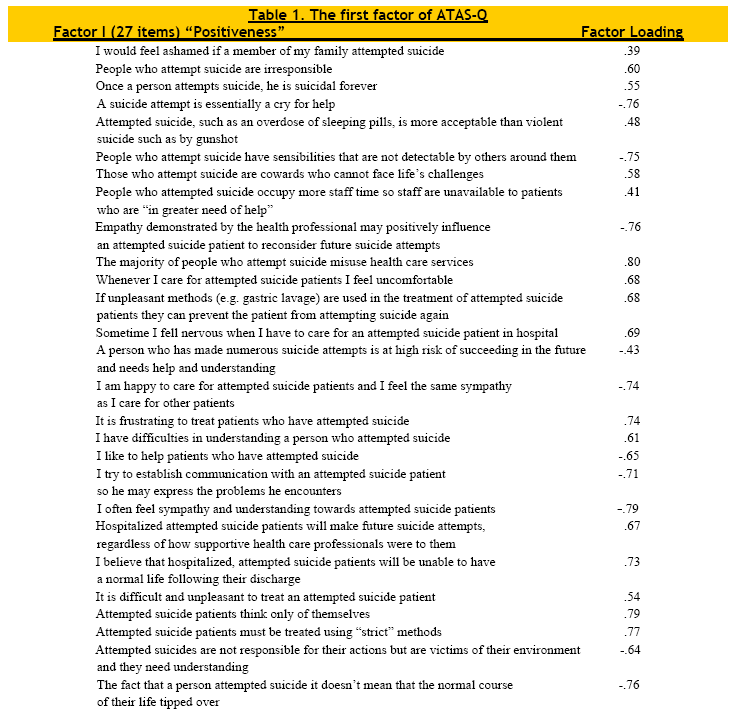
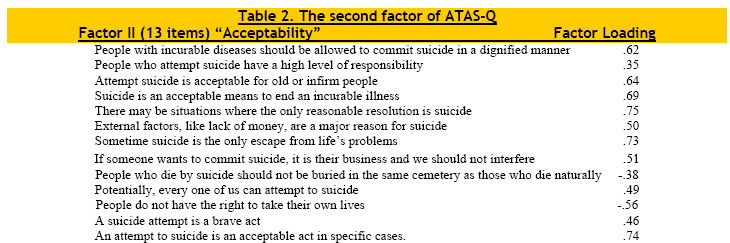
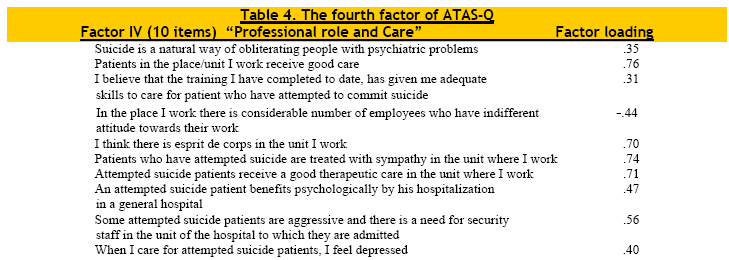
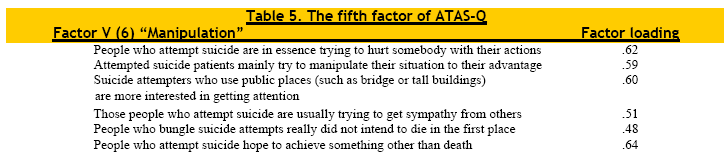
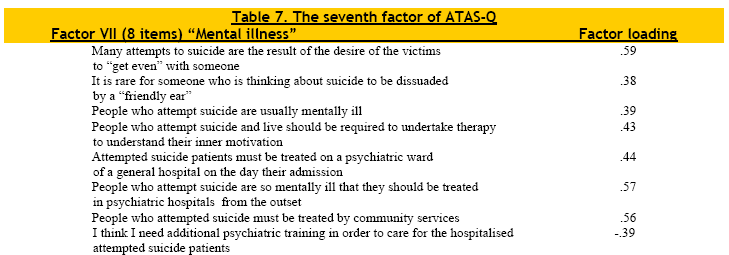
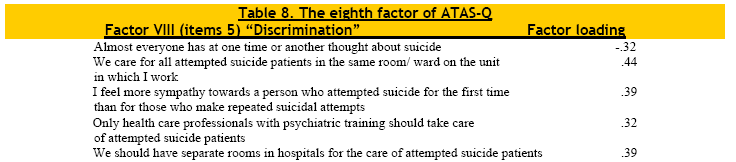
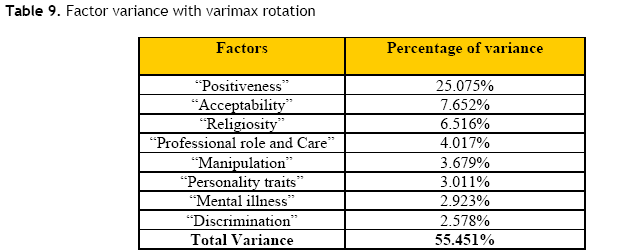
The calculated overall Kaiser-Meyer-Olkin (KMO) measurement of sample adequacy was 0.80 which suggests that the data were suitable for a factor analysis. From the factor analysis 8 factors extracted accounted for 55.451% of the total variance. Twenty two items were removed and the resultant “Attitudes Towards Attempted Suicide – Questionnaire” (ATAS-Q) comprised 80 attitudinal items, with a favourable attitude corresponding to ‘strongly agree’ and unfavourable to ‘strongly disagree’. The higher the overall score of the questionnaire indicates more positive attitude towards attempted suicide people. All items of the questionnaire with the factor loading are presented in tables 1-8.
The first factor entitled “positiveness” contains positive and negative attitudes of health care personnel to attempted suicide patients (table 1)
The second factor comprises attitudinal items which represent the level of “acceptability” of the acts of suicide and attempt suicide to health care personnel.
Factor entitled “religiosity” illustrates health care personnel attitudes which consider suicide and attempted suicide in relation to religious issues.

The “professional role and care” factor comprises items which refer to the care that attempted suicide patients receive or should receive as well as aspects of the professional role and work environment of health care personnel.
Factor “manipulation” illustrates health care personnel beliefs that attempted suicide patients try to manipulate their environment.
Factor “personality traits” illustrate items that outline the character and traits of people who attempt suicide.

The mental illness factor comprises items which relate suicide and attempted suicide to mental illness.
The last factor refers to discriminations attitudes of health care personnel towards suicide and attempted suicide.
The interpretable factors were extracted and the accounting variance of each factor explained as illustrated in Table 9.
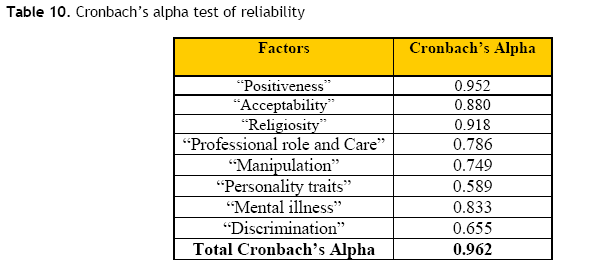
Cronbach’s alpha test of reliability was performed for each factor and the overall ATAS questionnaire, results are presented in Table 10. In retest assessment of ATAS- questionnaire revealed Pearson r= 0.997.
Discussion
The construction of the Attitude Towards Attempted Suicide Questionnaire is the first attempt in Greece to measure attitude towards attempted suicide people. Factor analysis of the questionnaire suggests that the attitude to suicide and attempted suicide is a complex phenomenon which must be explored in a number of dimensions rather than just the two opposing poles of positive or negative attitude of respondents6. Each factor represents a different dimension to explain the form of health care personnel attitude towards attempted suicide people. Therefore, the adoption of ATAS-Q makes it possible to measure the attitudes of health care personnel towards people who attempt suicide.
The factors which emerged from factor analysis seem to cover the extension of what is understood as attitude in its cognitive, affective and behavioral component. In particular, the factors which emerged under the title of “positiveness”, “personality”, “mental illness” and “religiosity” illustrate the cognitive aspect of attitude. The factor entitled “acceptability” represents the affective aspect of attitude. Furthermore, “professional role and care”, “manipulation” and “discrimination” were components of the behavioral aspect of attitude.
Though the factors which emerged reflect the Greek doctors’ and nurses’ attitudes towards attempted suicide it seems that most of them are conceptually similar to those identified by previously validated instruments [6,20].
Conclusions
Testing of the ATAS-questionnaire which was constructed by the utilization of validated instruments as well as from attitudinal dimensions of the literature review revealed that is a useful tool in measuring attitudes towards people who have attempted suicide. Testing confirmed high internal consistency and stability as a measurement tool with good face and construct validity.
However, it has to be acknowledged that further refinement is needed, with testing in a larger sample and with variables that may influence health care personnel attitudes towards attempted suicide people.
References
- World Health Organization (WHO). Suicide prevention: Emerging from darkness. Geneva:WHO, 2001.
- Koulouri A. Suicidal behaviour and primary health care services. Nosileftiki 2009, 48(3): 292-299.
- Hawton K. and Catalan J. Attempted Suicide - A Practical Quide to its Nature and management. Oxford University Press, 1982.
- Sethi S. and Uppal S. Attitudes of clinicians in emergency room towards suicide. International Journal of Psychiatry in Clinician practice. 2006, 10 (3): 182-185.
- Ramon S. Attitudes of doctors and nurses to self-poisoning patients. Social science and Medicine 1980, 14: 317-324.
- Domino G., Westlake L., & Gibson L. Attitudes towards suicide. A factor analytic approach. Journal of Clinical Psychology, 1982, 38:257-262.
- Skevington S. Understanding Nurses-The social Psychology of Nursing. John Wiley and Son, LTS, New York, 1984.
- Botega N.J., Reginato D.G., Da Silva C.P et al. Nursing personnel attitudes towards suicide: the development of a measure scale. Rev Bras Psiquiatr, 2005 27 (4):315-318.
- Oppenheim A.N. Questionnaire design, interviewing and attitude measurement. New Edition, Pinter, London, 1996.
- Seremet N.K. Needs of the attempted suicide patient in the ICU. Critical care Nursing Quarterly 1984, 6 (4): 40-48.
- Leu SJ. Nurses attitudes and difficulties in nursing intervention toward suicidal behavior in emergency department. Unpublished MSc Dissertation, The Kaohsiung Medical College, Taiwan, 2002.
- Samuelsson M., Asberg M. &Gustavsson J.P. Attitudes of psychiatric nursing personnel towards patients who have attempted suicide. ActaPsychiatricaScandinavica 1997, 95: 222-230.
- Sun F.K., Long A. &Boore J. The attitudes of causalty nurses in Taiwan to patients who have attempted suicide. Journal of Clinical Nursing, 2007, 16, 255-263.
- McLaughlin C. Causalty nurses? attitudes to attempted suicide. Journal of Advanced Nursing 1994, 20: 1111-1118.
- Segal DL., Mincic M.S, Coolidge FL.&O?Riley A. Attitudes toward suicide and suicidal risk among younger and older persons. Death studies 2004, 28: 671-678.
- Wang W.L., Anderson F.R. &Mentes J.C (1995). Home health care nurses? knowledge and attitudes toward suicide. Home Health Care Nurse, 1995 13: 64-69.
- Sun F.K., Long A. &Boore J. The attitudes of causalty nurses in Taiwan to patients who have attempted suicide. Journal of Clinical Nursing, 2007, 16: 255-263.
- Leu SJ Nurses attitudes and difficulties in nursing intervention toward suicidal behavior in emergency department. Unpublished MSc Dissertation, The Kaohsiung Medical College, Taiwan, 2002.
- Bailey SR. Critical care nurses? and doctors? attitudes to parasuicide patients. The Australian Journal of Advanced Nursing 1994, 11: 11-17.
- Suokas J. and Lonnqvist J. Staff?s attitudes towards patients who attempted suicide. Ed. by Diekstra et al. Suicide and its Prevention. The role of attitude and imitation. Advances in Suicidology 1989, 1:227-248.
- Suominen K., Suokas J., Lonnqvist J. Attitudes of general hospital emergency room personnel towards attempted suicide patients. Nord J Psychiatry, 2007, 61 (5):387-392.
- McAllister M., Creedy D., Moyle W. Farrugia C. Nurses? attitudes towards clinets who self harm. Journal of Advanced Nursing, 2002, 40 (5):578-586.
- Streiner D.L. & Norman G.R. Health Measurement Scales: A Practical Guide to their Development and Use. 2nd ed. Oxford University Press, Oxford, 1995.
- Kline P. An easy Guide to Factor Analysis. London, Routledge, 1994.
- Tompson B. & Daniel L.G. Factor analysis evidence for the construct validity of scores: a historical overview and some guidelines. Educational and Psychological Measurement 1996, 56 (2):197-208.
- Tabachnick B.G &Fidell L.S. Using Multivariate Statistics, 4th ed. Allyn and Bacon, Needham Heights, USA, 2001.

Open Access Journals
- Aquaculture & Veterinary Science
- Chemistry & Chemical Sciences
- Clinical Sciences
- Engineering
- General Science
- Genetics & Molecular Biology
- Health Care & Nursing
- Immunology & Microbiology
- Materials Science
- Mathematics & Physics
- Medical Sciences
- Neurology & Psychiatry
- Oncology & Cancer Science
- Pharmaceutical Sciences