Haemodialysis adequacy ââ¬â contemporary trends
Zyga Sofia
Sofia Zyga1* and Paul Sarafis2
1MSc, PhD, Assistant Professor, Nursing School, University Of Peloponnese, Sparta, Greece
2RN, MSc, PhD, Nursing School, University οf Peloponnese, Sparta, Greeceo
Abstract
Haemodialysis constitutes a prescribed clinical action, a fact which leads us to the search of indexes that control the adequacy of haemodialysis and to a more precise estimation of the intended and the performed result. Objective: The purpose of this literature review was to present the quantitative and mathematical indexes used for the calculation of the haemodialysis adequacy in the daily clinical practice. Method and material: The method οf this study included bibliography research from both the review and the research literature which carried out mainly internationally over the last years and referred to haemodialysis adequacy. Results: In daily clinical practice, useful tools for the calculation of haemodialysis adequacy are the indexes Urea Reduction Rate (URR), single-pool Kt/V (spKt/V) index, equilibrated Kt/V (eKt/V) index and weekly standard Kt/V (std Kt/V) index. The knowledge of factors that influence the urea clearance within treatment and can offer important help to the successful haemodialysis prescription, are: blood flow, filter permeability, haemodialysis dialysate flow and recirculation. Clinical indexes are may also be considered for a more effective haemodialysis process: good natural health, good regulation of arterial pressure, good regulation of liquids balance and absence of clinical points or uraemia symptoms. Conclusions: The main conclusion of the present review is to apply the indexes in daily clinical practice. Moreover, it is important to set out certain proposals for further research, so that the health professionals improve not only the clinical practice but also the theoretical approach in the field of determination and estimation of haemodialysis adequacy.
https://sporbahisleri.blogaaja.fi http://sporbahisleri.parsiblog.com https://spor-bahisleri.jimdosite.com https://sporbahisleri.edublogs.org https://sporbahisleri.websites.co.in https://sporbahisleri.podia.com https://sporbahisleri7.wordpress.com https://sporbahisleri.jigsy.com https://niwn-chroiaty-mcieung.yolasite.com https://spor-bahisleri.mywebselfsite.net https://sporbahisleri.mystrikingly.com https://sporbahisleri.splashthat.com https://sporbahisleri1.webnode.com.tr https://sporbahisleri.odoo.com http://sporbahisleri.creatorlink.net http://www.geocities.ws/sporbahisleri/ https://spor-s-site.thinkific.com https://artistecard.com/sporbahisleri https://sporbahisleri.estranky.cz https://spor-bahisleri.mozellosite.com https://651be6b563e56.site123.me https://betsitesiinceleme.blogspot.com https://sporbahisleri.hashnode.dev https://sporbahislerim.wixsite.com/spor-bahisleri https://sporbahislerix.weebly.com https://sites.google.com/view/betsiteleri https://codepen.io/sporbahisleri https://sporbahisleri.bcz.com https://www.smore.com/6rsb9
Keywords
Adequacy, Haemodialysis, Kt/V index, Nursing, Uraemia.
Introduction
The main purpose of haemodialysis is the provision of sufficient and safe patient treatment, which contributes to the better physical fitness of the patient and it prevents further complications that are due to uraemia. The provision of sufficient adequacy presupposes the application of two conditions: the first one pertains to the amount of haemodialysis that each patient needs and the second to the amount of haemodialysis that can be offered to the specific patient [1].
Haemodialysis is a prescribed clinical action, which means that it is essential to continuously search for indexes that control the adequacy of haemodialysis and have a more precise estimation of the intended and the performed result. Today, many efforts are made to find a method to measure the precise dose of haemodialysis. Taking into account the attempt to objectively evaluate haemodialysis with quantitative and mathematical indexes and the great clinical interest of this subject, we further present these indexes and their importance for an adequate haemodialysis, so as these can become functional tools in our daily clinical practice [2].
Kt/V index is considered as the prevailing index of haemodialysis adequacy. Urea Reduction Ratio (URR) is also considered as a simple and important index. The basic element of both indexes is blood urea, which is the most useful parameter for the quantification and estimation of haemodialysis adequacy. There is always a danger, however, to over-estimate the outcome of haemodialysis. The reasons for this overestimation, as they are reported in bibliography are the following: the blood reception for determination of urea is usually made in the beginning and immediately after the end of the therapy; this may overestimate the haemodialysis output, because there is no calculation of the urea rebound. In addition, the cardiopulmonary recirculation effect must also be considered; this causes a difference of blood urea concentration between filter entrance and the peripheral veins in the order of 8-11% [2,3,4].
Therefore, the knowledge of factors that influence the urea clearance within treatment and can offer important help to the successful haemodialysis prescription, are: blood flow, filter permeability, haemodialysis dialysate flow and recirculation [5].
Clinical indexes are may also be considered for a more effective haemodialysis process: good natural health, good regulation of arterial pressure, good regulation of liquids balance and absence of clinical points or uraemia symptoms.
Urea removal indexes
The urea removal indexes include: urea reduction ratio (URR), single-pool (spKt/V), equilibrated (eKt/V) and the weekly standard index (std Kt/V) [6,7].
1. Urea Reduction Ratio Index (URR)
Today, the most forward index of haemodialysis adequacy is the urea reduction ratio (URR), which is a consequence of therapy and is calculated as follows: If we consider that the SUN (weekly profile N of serum urea) is 60 mg/dl before the haemodialysis and 18 mg/dl afterwards, then the relative reduction of SUN is (60-18)/60=0.70. Conventionally this index is expressed as percentage (%), hence in our case the URR is 70% [6].
2. Definition of single-pool index spKt/V
According to Daugirdas JT, et al., [6] most of the published studies have used the spKt/V as an index of haemodialysis adequacy and refer to it as a measure for urea removal. Gotch and Sargent during the revision of NCDS in 1985 simplified the spKt/V index. The value of spKt/V<0.8 was associated with high morbidity probability or therapy failure. Other studies supported that spKt/V index is related with the mortality of patients that are submitted to haemodialysis. The spKt/V index is defined as the amount of serum that is cleared from urea via the distribution volume, in relation to the urea reduction ratio during haemodialysis. Parameter K corresponds in Clu+ of the water in blood that is provided by the filter (L/h), t is the duration of the haemodialysis session in hours (hr) and V is volume of urea distribution in combination with the body water in litres (L). This index lacks of measurement units. If the accredited index is 1.0 this means that the relation K x t, or the total volume that is cleared during the haemodialysis session is equal to V that is the urea distribution volume.
Calculation of spKt/V from URR
The basic relation between spKt/V and URR can be adapted for the effect the g and UF. The basic equation that correlates the spKt/V and URR is: spKt/V = - ln (1-URR). Thus, if we define as R the SUN pre / SUN post, then R=1-URR and the equation now becomes: spKt/V = - ln (R). The adapted equation (adaptation of g and reduction of volume) is the following:
spKt/V = - ln (R - 0.008 x t) + [4 - (3.5 x r)] x 0.55 UF/V,
where “t” is the duration of haemodialysis session in hours (hr), UF the ultrafiltration volume during haemodialysis in litres (L) and the V is the volume of urea distribution after the session in litres (L). The term 0.008 x t correlates the SUN post haemodialysis / SUN prior haemodialysis (R) in urea production during session and is determined by the session’s duration. For sessions of 3-4 hours duration, the parameter of urea production fluctuates between 0.024-0.032.
The second parameter of adaptation balances the increase of spKt/V due to the volume (V) reduction after the session, which usually adds approximately a 10% in the non adapted spKt/V. If the volume (V) is not known, then an anthropometric calculation can be used or alternately, the volume (V) can be estimated as the 55% of body weight after session (W). Thus, the equation is simplified as follows:
spKt/V = - ln ( R - 0.008 x t) + [4 - (3.5 x R)] x UF / (0.55 W)
It becomes clear that in order to achieve spKt/V=1.0, URR should almost reach 60%, when fluids are not removed, contrary only 52% is required when 9% of the final body weight is removed after the session. The smaller value of URR reflects the additional urea removal that is related with the volume reduction. Consequently, parameters spKt/V and URR are connected mathematically and determined, mainly from the SUN levels before and after the haemodialysis session. In addition, the spKt/V index counts the ultrafiltration and the urea production. However, none of the parameters surpass the other as a denouement criterion [6,12-15].
3. Equilibrated Kt/V (eKt/V) index
In the lines above we have referred to the significance of the equilibrated Kt/V (eKt/V). In reality the eKt/V is typically 0.2 Kt/V units smaller than the spKt/V index, however this difference depends on the effectiveness or the haemodialysis rate. The eKt/V can be exported from spKt/V, from the calculation of urea rebound after the haemodialysis session by the following way:
eKt/V= spKt/V - rebound
An equation has been determined and evaluated, with which the degree of rebound can be forecasted according to the haemodialysis rate. With the use of this “rate equation”, there is no need to take blood 30-60 min after the end of the session [6,15]. This “rate equation” forecasts that:
Rebound = 0.6 x haemodialysis rate - 0.03 (for arterial access)
Rebound = 0.47 x haemodialysis rate - 0.02 (for venous access)
Replacing the term (spKt/V)/t with the haemodialysis rate, results to:
eKt/V= spKt/V - 0.6 x (spKt/V) / t + 0.03 (for arterial access)
eKt/V= spKt/V - 0.47 x (spKt/V) / t + 0.02 (for venous access)
In these equations t is expressed in hours and quotient (spKt/V)/t is simplified in K/V expressed in hr-1.
4. Weekly standard Kt/V (std Kt/V) index
Theoretically in any haemodialysis program, g and TAC values can be calculated with the use of a standardization program of urea kinetics and then converted in eClu+. This value can be added in the measured renal remaining function Clu+. The eClu+ value that emerges can be expressed in ml/min or in L/week. When it is expressed in L/week, the eClu+ is equivalent with K x t or in other words with the volume of serum that “was purgated” within a weeks period, this can be divided further with the volume (V) in order to provide the weekly urea Kt/V [7,8].
Haemodialysis Adequacy Clinical Practice Guidelines
According to NKF-KDOQI 2006 guidelines spKt/V>1.2 or URR>65% is recommended for maintenance, when a 3 times per week haemodialysis program is applied [6-8]. The above mentioned values constitute the lowest possible values and not the target values, which are 1.4 for spKt/V and 70% for URR. There is dispute on how much the application of an intensive haemodialysis program is beneficial. The HEMO multicenter study randomized haemodialysis patients in two groups, those with spKt/V value of 1.3 and those with 1.7. Patients with higher haemodialysis dose did not present higher sustenance levels or fewer admissions to a hospital. Also, they did not present higher alimentary or other kind of benefits.
Furthermore, other major, cross-correlation studies found that the mortality increases, when the value of spKt/V drops below 1.2.
Referring to the eKt/V index, the target value is 1.05 and 1.25 respectively. European Best Practice Guidelines recommend the use of eKt/V index and determine their target value at 1.4, in other words they recommend higher haemodialysis dose comparing to KDOQI 2006.
As for the Kru, the guidelines of KDOQI 2006 for the minimal haemodialysis dose in a 3 times per week program are: 1.2 for patients with Kru<2.0ml/min/1.73m2 and 0.9 for patients where Kru>2.0. The recommended target value spKt/V was set 15% higher from the lowest value, thus target spKt/V in a 3 times per week program is 1.4 and 1.15 in patients without and with residue renal function, respectively.
For therapies different from 3 times per week sessions, in order to achieve the calculated basic Kt/V=2.0, the proposed minimal values of spKt/V are the following:
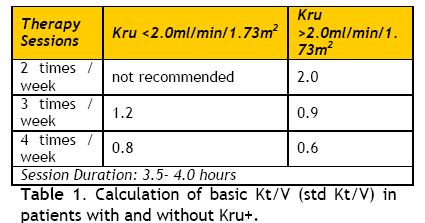
There are tables which help us in the calculation of stdKt/V for each provided haemodialysis therapy8. The minimum value for stdKt/V should be at least 2.0. Perhaps it is wiser in women and in smaller-sized patients to set this minimum a little bit higher. In patients with Kru >2, the minimum target value of stdKt/V can be set at 1.7 for a 3 times per week haemodialysis program and at 1.6 for therapies with 3-7 sessions per week 6-15.
Guidelines for taking a blood sample to measure SUN after the haemodialysis session
The sampling method is the following:
➢ Annihilate the ultrafiltration rate.
➢ Decrease the blood flow to 100ml/min for 10-20 sec.
➢ Stop the pump.
➢ Receive a sample, either from the blood sampling port of the arterial line, or from the tube that is connected with the arterial needle.
The alternative method that is proposed is:
➢ Annihilate the ultra filtration rate.
➢ Regulate the filter in extracorpal circulation.
➢ Maintain QB in regular rate and wait for 3 min.
➢ Take blood sample.
Reasons for which the outcome from the URR single-pool Kt/V index can differ from the determined Kt/V
Reasons for which the attributed Kt/V can be lower than the determined Kt/V (in this case, the standard volume V will be increased):
➢ Patient’s Volume V is bigger than its initial estimation.
➢ The real QB is smaller than the one that has been marked in the blood pump (this often happens when the arterial pressure prior to the pump is high).
➢ Transitory reduction of QB, because appearance of symptoms or for other reasons.
➢ The real session duration is smaller than the determined one.
➢ΚοΑ is smaller than the expected (e.g. erroneous technical specifications of manufacturer etc).
➢ Recirculation in the site of arterial access.
➢ Needle inversion from negligence.
➢ Rebound (due to delayed blood sampling for the determination of SUN, so that spKt/V and volume V can be calculated).
Reasons for which the attributed Kt/V can be higher than the determined Kt/V (in this case, the standard volume V will be decreased):
➢ Patient’s volume V is smaller than its initial estimation.
➢ Technical failure that falsely gives low SUN value after the haemodialysis session.
➢ Recirculation in the site of arterial access or needle inversion from negligence, resulting into mixture of blood that is purgated with blood that comes out prior to the filter (especially if before blood sampling there was no period of slow blood flow).
➢ Sampling from the blood line that comes out from the filter.
➢ The session’s duration was higher than the one recorded.
➢ Recent correction of recirculation in the site of arterial access or needle inversion from negligence [6-15].
Discussion
From all the above, we can safely say that useful tools for the calculation of haemodialysis adequacy in daily clinical practice, are the indexes of urea removal, in other words, urea reduction rate (URR), single-pool Kt/V index (spKt/V), equilibrated Kt/V index (eKt/V) and the weekly standard Kt/V index (std Kt/V).
Appraising the haemodialysis adequacy one should not forget the co-assession of parameters that are related to the morbidity, the survival, the patients quality of life (how well patients feel) and the financial cost [16]. An adequate haemodialysis can be considered that which achieves high rate of survival, low mortality rates and superior quality of life. In regard of morbidity, it mainly relates with the appearance of hypotension and arrhythmias, as well as with the rest of the patient’s health coexisting problems, such as diabetes, arteriosclerosis etc [1,3].
As far as survival is concerned, from short term studies and from NCDS, how the repercussion of Kt/V increments on the renal patient’s survival isn’t clearly realized. It appears thus, that the value of increased provision of the haemodialysis dose finally achieves to improve the renal patient’s survival [17].
Examining the aspect of quality of life is exceptionally difficult, since each individual determines the quality of life in their own way, and can be a result of many factors such as social, economic, cultural or even a metaphysical perception of their life. Therefore, in order to evaluate this parameter, it is important to import subjective factors (cognitive and emotional dimensions such as e.g. ambitions, income, health, self-cognizance, self-respect and objective variables (physical status and daily activities) and to seek the repercussions in each individual’s sectors of activities, such as home life, work, interpersonal relations etc [17,18].
Finally, the financial cost implication in the effectiveness of haemodialysis as a therapeutic method for renal function substitution should be considered by every country’s health system. Modern health policies, independently from the form of organizing and financing of the health system, converge in the control not only on the part of the financial cost of the health services, but also in the withholding of health expenses, both in the public and private sector. Control to the public health expenses is imposed due to their continuous and unverifiable increase that has as a consequence the deprival of public expenses from the remaining social sectors. In the private sector, due to inflating health services costs, family planning is eminently overloaded, with direct and indirect financial repercussions and the violation of the basic human right to access health services. In such a frame that is characterized by control policies and cost restrictions, as well as rational distribution of funds, effectiveness should also be evaluated [19,20].
Moreover, one should take into account the results of a therapeutic method to characterize its adequacy, inadequacy or even over-adequacy. In case of haemodialysis the therapy is considered insufficient when it leads to increased mortality and morbidity but also to deterioration of patient’s quality of life. Such therapy also involves high financial cost. On the other hand, the haemodialysis should be considered over-adequate, when, despite its intensive application, it does not improve patient’s mortality and morbidity, while it worsens their quality of life and increases the financial cost. However, in order to determine whether a method is insufficient or over-efficient it must be compared to a sufficient therapy. In the case of haemodialysis, as it has already been emphasized, the question of which is the most sufficient therapy has no simple and easy answer. In general, one can characterize the haemodialysis as sufficient, when it ensures good quality of life, has bearable financial cost and is granted in such doses that further increase does not augment patients’ mortality and morbidity [1,3].
Furthermore, the apposition of all the above facts simply implies that the effort to increase the haemodialysis effectiveness constitutes an imperative need of daily clinical practice. The problem is that the value of Kt/V is not known and despite its increase, there is no improvement of the offered result [6]. As a result of this flaw in the method, we can estimate the limits of an insufficient haemodialysis, can evaluate the limits of a sufficient haemodialysis but we are unable to determine the limits of an ideal haemodialysis. Perhaps this situation is in the patients’ best interest, because the objective to achieve ideal haemodialysis fails by the effort of permanently increasing the offered treatment.
Conclusion
This study mainly aims to apply the results in daily clinical practice in favor of the patient and incidentally aims in the sensitization of health professionals for further research. Finally, it is important to set out certain proposals for further research, so that we improve the clinical practice and also the theoretical approach in the field of determination and estimation of haemodialysis adequacy:
➢ Observational studies for the possibility of application and the long-lasting reliability of the equations that calculate the equilibrated Kt/V index.
➢ Multicenter studies on the after-effects of haemodialysis dose in therapy’s outcome, so much for adults and pediatric dialysis patients too.
➢ Cost-result and cost-benefit studies altering the factors that influence urea clearance during the session which means blood flow, solution flow, filter permeability and time duration.
➢ Qualitative studies for evaluation of haemodialysis patient’s quality of life.
➢ Prospect comparative studies for evaluation of effectiveness between various methods of extrarenal purgation.
Bibliography
- Agrafiotis A. Haemodialysis using artificial kidney. Found in: Papadimitrioy M. et al. Nephrology. Medical Publications A. Sioki, Thessalonica, 1992:429-447.
- Kalochairetis P, Drouzas A, Blamis H, Makryniotou I, Zermpala S, Arbaniris N, et al. Determination of haemodialysis output on the base of blood urea taken in various session times. Files of Greek Medicine. 2003;20 (1):42-48.
- Agrafiotis Th. Haemodialysis adequacy. The objectivity of a medical action. Technogramma Publications, Athens, 1996.
- Agrafiotis Th. Index of haemodialysis adequacy. - Kt/V: its adequacy in dispute? Hellen. Nephrol. 2001;13 (3):225-228.
- Chatzigiannakou D. The mathematic regard of haemodialysis adequacy in clinical practice. Found in: Agrafiotis Th. Haemodialysis adequacy. The objectivity of a medical action. Technogramma Publications, Athens, 1996.
- Daugirdas JT, Blake PG, Ihg TS. Handbook of dialysis. 4th edition. Editorship Zirogiannis P., Provatopoulou S. Athens, Ε.ΚΟ.Ν.Υ. Editorial Section, Athens,2008.
- Website: Urea Kinetics calculators: https://www.hdcn.com/calc.htm. Accessed June 2009.
- Website: HDCN adequacy channel: https://www.hdcn.com/ch/adeq. Accessed June 2009.
- Gotch FA. Kinetic modeling in hemodialysis. In: Clinical dialysis. Appleton and Lange. 1989:118-146.
- Depner TA. Prescribing Hemodialysis. A Guide to urea modeling. Kluwer Academic Publishers, Boston, 1991.
- Ellis P, Malchesky PS, Magnusson MO, Goormastic M, Nakamoto S. Comparison of two methods of kinetic modeling. Trans. Am. Soc. Artif. Intern. Organs.1984;30:60.
- Daugirdas JT, Depner TA, Greene T, Kuhlmann MK, Levin NW, Chertow GM, Rocco MV. Surface-area-normalized Kt/V: a method of rescaling dialysis dose to body surface area-implications for different-size patients by gender. Semin Dial.2008;21(5):415-21.
- Daugirdas JT. Prescribing and monitoring hemodialysis in a 3-4 x/week setting. Hemodial Int. 2008;12(2):215-20.
- Daugirdas JT, Greene T. Dialysis dose as a determinant of adequacy. SeminNephrol. 2005;25(2):76-80.
- National Kidney Foundation (NKF)-Dialysis Outcomes Quality Initiative (DOQI) Clinical Practice Guidelines and Clinical Practice Recommendations 2006 Updates for Hemodialysis Adequacy.
- Gokal R. Quality of life in patients undergoing renal replacement therapy: Kidney Int 1993; 40:(Suppl 40) S23-S27.
- Sarris Μ, Soulis S. Haemodialysis Patients Quality of Life. A critical approach. Medicine 2001;79:158-163.
- Kontodimopoulos Ν, Niakas D. The use of KDQOL-SF TM for calculating the health relative quality of life of greek dialysis patients. Files of Greek Medicine.2007; 24(6):590-599.
- Gitona Μ, Ifantopoulos Ι. Management of public hospitals in Greece, Medical.1995; 67:133-141.
- Zyga Sofia. The effect of blood and solution flow in the haemodialysis effectiveness. Doctoral thesis. Athens, 2003.
Open Access Journals
- Aquaculture & Veterinary Science
- Chemistry & Chemical Sciences
- Clinical Sciences
- Engineering
- General Science
- Genetics & Molecular Biology
- Health Care & Nursing
- Immunology & Microbiology
- Materials Science
- Mathematics & Physics
- Medical Sciences
- Neurology & Psychiatry
- Oncology & Cancer Science
- Pharmaceutical Sciences