Parameters that contribute to selecting the ambulatory surgery for cataract operation
Kelesi – Stavropoulou Martha
Martha Kelessi-Stavropoulou1*, Georgia Fassoi- Barka2, Vasiliki Koutsopoulou-Sofikiti3, Christina Sotnikova4, Evgenia Vlachou5, Georgia Toulia6
1Assistant Professor, Faculty of Nursing Β′, ΤΕΙ of Athens
2Lecturer Faculty of Nursing Β′, ΤΕΙ of Athens
3Assistant Professor, Faculty of Nursing Β′, ΤΕΙ of Athens
4RN, Red Cross Hospital, Athens
5Assistant Professor, Faculty of Nursing Β′, ΤΕΙ of Athens
6Lecturer, Faculty of Nursing Β′, ΤΕΙ of Athens
- *Corresponding Author:
- Martha Kelesi – Stavropoulou
Polemi 3, Drosia, 145 72
Tel: 2106229960, 6944634596
E-mail: mkel@teiath.gr
Abstract
The aim of the present study was to evaluate which parameters lead patients to the choice of cataract operation with ambulatory administration. Method and material: The sample studied consisted of 204 registers of two groups, who were submitted for cataract operation. Data were collected by a data register which included demographic variables, the medical history, the level of satisfaction and ophthalmologic measurements. Analysis of data was performed using the SPSS statistical package and Kolmogorov-Smirnov, x2 or Fisher exact test, t-test, while for the test, Mann-Whitney were applied for the statistical process. Results: The sample consisted of 86 men and 118women. The results showed that the final operation outcome (visual acuity-post operationally) between two groups, was equal. The comparison between hospital and ambulatory administration, of average values of the final visual acuity between hospital and ambulatory administration did not present statistically significant difference, p=0.730. The results showed higher satisfaction from administration of cataract operation appeared (73%) on the ambulatory basis compared to the hospital one (24%). Ages onding percentage (10,8%) of patients who came in the private centre, p=0,003. Conclusions: From the above, one could conclude that ambulatory administration of cataract consists in the best alternative solution, because it is danger free, safe and cost-effective.
Keywords
contributing parameters, cataract operation, ambulatory surgery
Introduction
Ambulatory Surgery constitutes an alternative kind of surgery, which not only provides safety of procedure and financial benefits, but also demands full cooperation of patients with health professionals. Moreover, it favors the creation of a health care system, which satisfies both patients and employees [1-6].
In international literature there has been a lot of discussion about the constantly increasing needs for high quality health services, given that financial resources are limited. Many of the health systems of developed countries are seeking solutions, which will combine high quality health services as well as procedures, which will be both effective and efficient in terms of cost [7,8,9].
It is worth noting that, Greece preceded other developed countries in terms of the introduction of operations on an ambulatory basis by the private sector. Τhis introduction took place in Greece in 1981, while in France and Great Britain in 1984 [10].
Ambulatory Surgery is defined as a non-urgent operation, which can be applied through general or local anesthesia and stay for medical observation for up to 13 hours. This period of time includes admission of patient, operation and medical observation until his discharge. Operations of ambulatory Surgery can take place in hospitals or well equipped specialized centers outside hospitals, where all safety conditions are fulfilled.
Relevant studies on ambulatory surgery have been appeared in literature since 1992 with increasing frequency. In most of them, it is estimated that the financial benefit, the quality of care as well as the patients' satisfaction are higher in comparison to traditional hospital surgery [11,12].
The countries of the Organization for Economic Cooperation and Development (OECD) and the International Organization for Ambulatory Surgery have already conducted a research study with a view to evaluating this type of surgery. They have examined the extent of its application and the potentiality of its expansion to more surgical operations, without any decrease in the quality of the provided care to patients. In this study there is a list of 20 reference groups of procedures frequently performed on an in hospital and in ambulatory basis as well [13].
In Greece, up until today, there has been very little effort towards detecting and evaluating the financial consequences of different health interventions. However, this task could prove increasingly important for the setting of the basic priorities in the health domain and the marking out in a rational way of the general health policy [1,3].
In the last ten to fifteen years, interest for handling of cataract ambulatory is gradually increasing. Cataract is a very common disease, as it corresponds to about half of the cases of people who have problems of vision. The percentage of individuals with cataract problem is increasing with age, and it is estimated by the American Academy of Ophthalmology (1995) that about 70% of people over the age of 75 years are presented with it [14]. Recently in the United Kingdom it was estimated that 80% of patients with cataract, in the post-operational phase, regained normal vision [15,16]. In the developed world the routine therapy is the surgical operation with excellent results. In 1990 Audit Committee suggested that 20% of surgery cases of cataract could have been held on an ambulatory basis [17].
In the cure of cataract, the new medical techniques and the rapid development of technology in the operation and implantation of Len have improved the medical results (restoration of long-and short-sightedness) as well as reduced risks (health problems) and restoration to health, which is hence the least possible. As a result, ambulatory surgery is not just a theory but a successful application [15,18,19].
A recent report by the Audit Commission (England and Wales) underlines the fact that more than 186.000 patients per year could be cured, if health authorities used ambulatory operation for the 20 most common procedures, one of which is that of cataract [17].
A study by Watts and Pearce brings into the light the very good results of ambulatory cataract operation handling, the saving of financial resources, which could be spared for other health domains and the ability of decrease of waiting lists for the particular operation. Emphasis has been laid on the fact that the more patients are operated on an ambulatory basis the more hospital beds are vacated [20].
AIM: The aim of the study was to evaluate which parameters lead patients to the choice of cataract operation with ambulatory administration.
Material-method
The sample study consisted of 204 patients from whom, 102 eligible patients (39 men and 63 women) from the ophthalmologic clinic of “Ippokratio” Hospital who were operated and hospitalized for two days (hospital administration). The rest 102 eligible patients (47 men and 55 women), from a private ophthalmologic centre, who were operated without post-operation hospitalization (ambulatory surgery).
For the collection of data, a data register was compiled, in which the socio-demographic data such as the educational level, the marital status, the income, the insurance fund were entered and clinical characteristics, the individual and hereditary medical history, the ophthalmologic measurements, measurements of visual ability as well as satisfaction from the latest visit were entered.
All participants met the requirements which had been set by the researchers in the first place: to be over 60, in terms of age, to have had a cataract operation only to one eye, the operation to be singularly a cataract one and not in combination with glaucoma. All the above were completed by the researchers. A part of them, after an interview with the patients, and the rest, from the data in the medical files at the hospital and the private center, and from information given by the doctors.
Statistical analysis: In terms of qualitative variables, their percentage was estimated. For every qualitative variable the mean value and the standard deviation were estimated. Qualitative variables were tested in terms of whether they follow regular distribution through the Kolmogorov-Smirnov test. The variables of age and duration of operation were used as qualitative as well. For the qualitative variables, inspections were carried out with the x2 ? Fisher exact tests.
Tests of quantitative variables which follow regular distribution were done with t-test, whereas for the rest Mann-Whitney test was applied. In addition, in order to find the determiners of patients’ preference to be operated on a hospital or ambulatory basis the model of logarithmic (accounting) regression was applied.
All statistical proofs were done on a significance level of a=0,05 and the statistical pack SPSS was used.
Results for the patients with hospitalized administration
Descriptive analysis
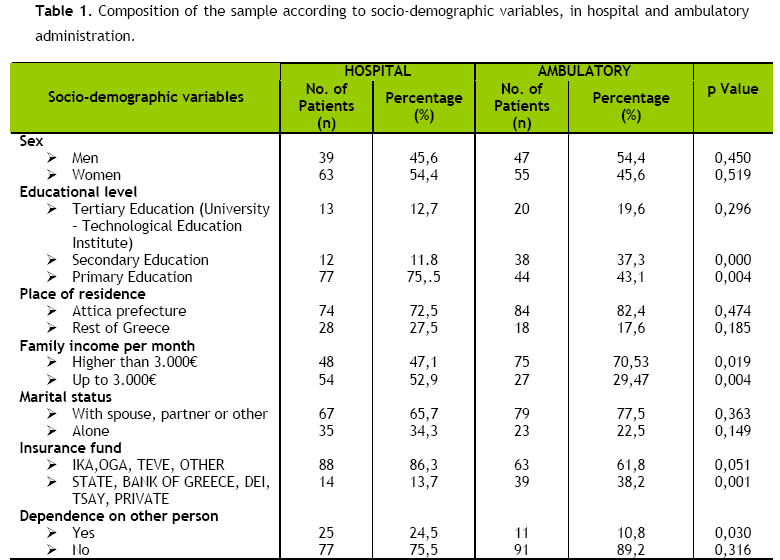
Of the 102 participants, 39 were men (45,6%) and 63 were women (54,4%). Regarding education level, 77 patients (75,5%) were of primary education, 12 patients of secondary (11,8%) and 13 patients of tertiary education (12,7%). The place of residence of 74 patients (72,5%) was Attica prefecture, while 28 patients (27,5%) came from the rest of Greece. Monthly family income more than 3.000€ had 48 patients (47,1%), while less than 3.000€ had 54 (52,9%). 67 patients (65,7%) lived with a spouse or some other person, while 35 patients (34,3%) lived alone. 88 patients (86,3%) had insurance funds ΙΚΑ, ΟGΑ, ΤΕVΕ, while 14 patients (13,7%) had as insurance funds State, Bank of Greece, DEI, ΤSΑΥ and private insurance. 77 patients (75,5%) were able to instill collyria or other local medicines into their eyes without the help of another person, while 25 patients (24,5%) felt unconfident to do something like that, either because they had never done it and were not sure whether they would manage, or because they would prefer somebody else to do this for them for safety reasons. (Table,1)
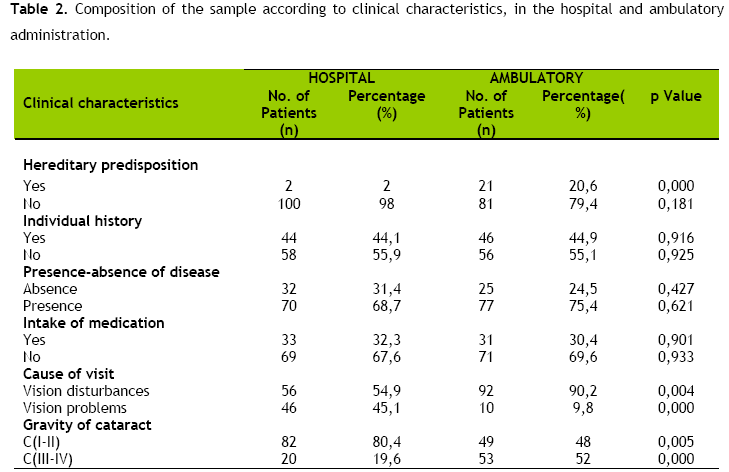
The composition of the sample under study in terms of individual-hereditary history (general and ophthalmologic), the gravity of cataract (hardness of lens) as well as, satisfaction of patients, from the whole administration, of the operation, were as following: 2 patients presented hereditary predisposition, while 100 patients had clear hereditary history. The individual ophthalmologic history of 44 patients (44,1%) was aggravated by some kind of ophthalmologic problem, while 58 patients (55,9%) did not have any problem. 32 patients (31,4%) did not present any other illness (apart from the ophthalmologic one) while 70 patients (68,7%) had one or more illnesses like hypertension, diabetes, heart diseases, lung diseases, hypercholesterolemia etc.69 patients (67,6%) took one or even more medicines (ophthalmologic or not), while 33 patients (32,3%) did not take any medicine. Minor disturbances in vision were the reason for visiting the hospital for 56 patients (54,9%), while graver problems in vision were mentioned as reasons for visiting for 46 patients (45,1%). 20 patients (19,6%) entered hospital with cataract gravity C (III-IV), 2nd class (highest cataract gravity), while 82 patients (80,4%) belonged to the 1st class (lightest type of gravity). (Table, 2)
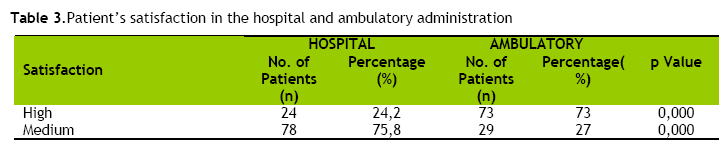
Very satisfied with the way of cataract administration (type of hospital admission, hospital care, direct result of the surgery) were 24,2% (24 patients), while 75,8% (78 patients) were medium to little satisfied.(Table, 3)
Results for patients with ambulatory administration
Descriptive analysis
Out of 102 patients with ambulatory administration, 47 were men (54,4%) and 55 were women (45,6%). Regarding education level, 44 patients (43,1%) were of primary education (the illiterate were included in this class), 38 patients (37,3%) of secondary education, while 20 patients were of tertiary education (University – Technological Education Institute), (19,6%). The place of residence for 84 patients (82,4%) was Attica prefecture while 18 patients (17,6%) came from the rest of Greece.75 patients (70,5%) had monthly family income higher than 3.000€ while 27 patients (29,5%) had monthly income up to 3.000€. 79 patients (77,5%) lived with a spouse, partner or some other person while 23 (22,5%) lived alone.63 patients (61,8%) had as insurance funds ΙΚΑ, ΟGΑ, ΤΕVΕ or some other, while 39 patients (38,2%) had as insurance State, Bank of Greece, DEI, ΤSΑΥ or some private insurance. 91 patients (89,2%) could instill collyrium in their eyes without help from another person, while 11 patients (10,8%) stated that they would prefer that somebody else did it for them. (Table,1)
The composition of the sample under study in terms of individual-hereditary history (general and ophthalmologic), the gravity of cataract (hardness of lens) as well as satisfaction of patients from the whole administration of the operation was as following: 21 patients (20,6%) had hereditary predisposition (ophthalmologic), while 81 patients (79,4%) did not have a predisposed ophthalmologic history. The individual ophthalmologic history of 46 patients (44,9%) was predisposed with one at least ophthalmologic problem, while 56 patients (55,1%) did not have any problem.77 patients (75,4%) also had some other disease, like diabetes hypertension, heart disease, lung disease and other degenerative diseases because of high age, whereas 25 patients (24,5%) did not have any of the above diseases.71 patients (69,6%) took one or even more medicines (ophthalmologic or not), while 31 patients (30,4%) did not take any medication. 92 patients (90,2%) from those who came to the ophthalmologic center mentioned as cause of visit some minor disturbance in vision (mainly disturbances during the evening hours) and 10 patients came to the center with grave vision problems (visual acuteness <2 for short or long distance). More than half of the patients (53) at a percentage of 52% presented higher cataract gravity, C (III-IV)-2nd gravity class, whereas 49 patients (percentage of 48%) had cataract of the 1st class C (I-II). (Table,2). 73 patients (73%) stated that they were very satisfied from the scheduling, the information, the personnel (nurses-doctors), the direct result of the surgery (visual acuteness), the duration of the whole procedure, whereas 29 patients (27%) stated that they were medium to little satisfied. (Table,3)
Inductive results
From the examination of independence of qualitative variables (Table, 1) on a significance level a=0,05 between hospital and ambulatory administration, the following results came into light:
There is a statistically significant difference in the educational level of patients who came to the hospital or the private centre. The percentage of patients with secondary education who come to the hospital (11,8%) is lower than the corresponding percentage (37,3%) of patients in the private centre (p=0,000). Statistically significant difference also exists in the monthly family income between patients who came to the hospital or the private center. The percentage of patients with monthly income up to 3.000€ who come to the hospital (52,9%) is higher than the corresponding percentage (29,47%) of patients who come to the private centre (p=0,004).There is a statistically significant difference in the insurance funds of patients who came to the hospital or the private center. The percentage of patients with insurance funds like State, Bank of Greece, DEI, ΤSΑΥ, Private insurance who come to the private centre (38,2%) is higher than the corresponding percentage (13,7%) of patients who come to hospital (p=0,001). Finally a statistically significant difference is observed in terms of dependence of the patient on another person among the patients who come to hospital (24,5%), which is higher than the corresponding percentage (10,8%) of patients in the private centre (p=0,003).
From the examination of independence of the qualitative variables of table 2 and on a significance level of a=0,05 between hospital and ambulatory administration, the following results came into light:
A statistically significant difference exists in the hereditary predisposition of patients who came to hospital or private center. The percentage of patients with hereditarily predisposed ophthalmologic history, who come to hospital (2%) is lower than the corresponding percentage (20,6%) of the patients in the private centre (p=0,000).
A statistically significant difference is observed in the gravity of cataract in patients who came to hospital or private center. The percentage of patients with higher cataract gravity [C(III-IV)] who come to hospital (19,6%) is lower then the corresponding percentage (52%) of patients in the private centre (p=0,000).
Finally, a statistically significant difference exists in the satisfaction of patients who came to hospital or private center.(Table, 3). The percentage of patients who stated that they were very satisfied from the administration of the surgery (organization-scheduling-result) came from the private centre (73%), as opposed to the patients from the hospital (24,2%), (p=0,000).
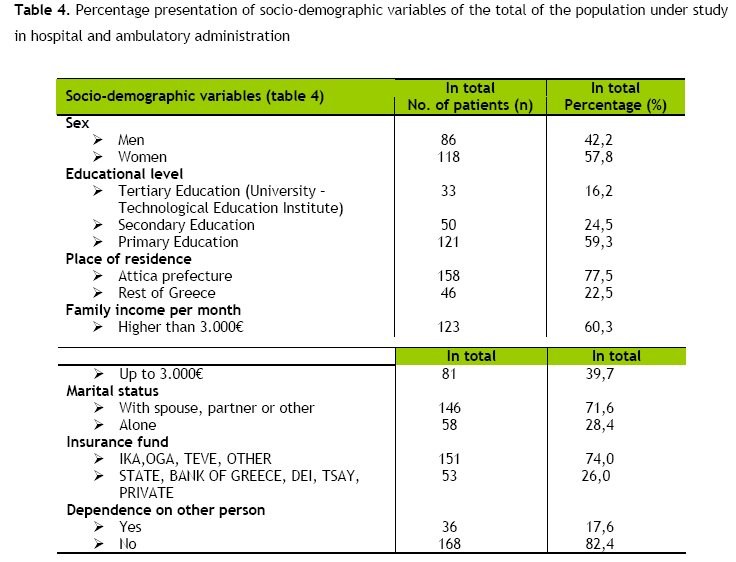
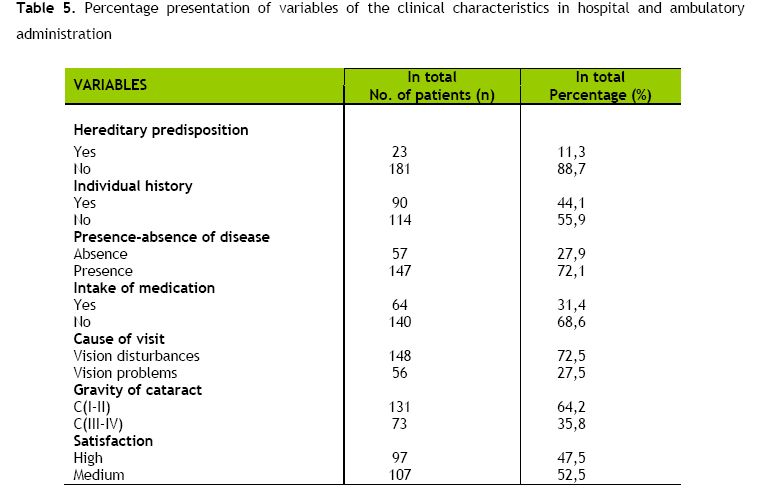
Tables 4, 5 and 6, present in an analytic way the numerical and percentage composition of the population under study in terms of the total of variables in hospital and ambulatory administration.

Statistical analysis of quantitative variables
In order to carry out the comparison of the mean values of the quantitative variables (age, visual acuteness and surgery duration) between hospital and ambulatory administration, there was an examination of the regularity in distribution of the corresponding variables with the Kolmogorov-Smirnov test and it was found that the above distributions of the variables can be considered regular.
In table 7 there is a comparison of the average ages, the visual acuteness and the surgery duration in min.
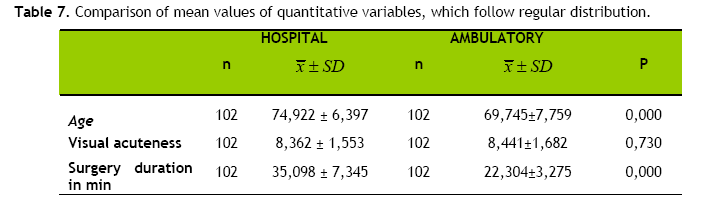
From the examination of the mean values of the above quantitative variables between hospital and ambulatory administration, the results of the study showed that: The average age (74,9) of the operated patients with hospital administration is higher than the average age (69,7) of the operated patients with ambulatory administration (p=0,000). The comparison of mean values of the final visual acuteness between ambulatory administration (private sector) and hospital (public sector) does not differ (p=0,730).The comparison of mean values of the surgery duration in min between ambulatory administration (private sector) and hospital (public sector) (35,09) is higher than the surgery duration in min (22,3), (p=0,000).
Determination of parameters which reinforce the application of ambulatory administration
From table 8 it becomes obvious that there is a strong connection between the type of administration of the cataract operation (ambulatory administration) and younger ages ≤ 70 of age (p=0,002), higher cataract gravity (p=0,000), shorter surgery duration (p=0,000) and higher satisfaction (p=0,000) of patients.
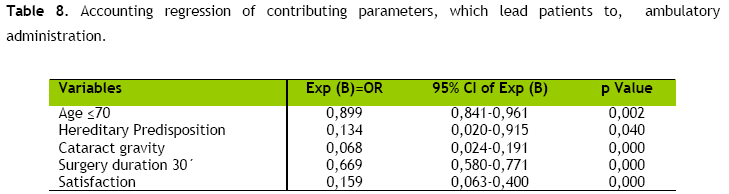
At ages (≤70 years) they prefer 1,042-1,191 times more the ambulatory administration than more advanced ages. Patients with predisposed heredity choose 1,092-5,076 more frequently ambulatory administration than patients with clear hereditary history.
Patients with higher cataract gravity (2nd gravity class) choose 5,245 – 41,224 times more frequently ambulatory administration than patients with cataract gravity of the 1st class correspondingly.
Shorter duration of surgery (≤ 30´) seems to be observed by 1,296-1,724 times more frequently in ambulatory administration correspondingly.
The highest satisfaction of patients seems to be observed 2,5-15,773 times more frequently in ambulatory administration correspondingly.
As it was obvious from the results of the research, ambulatory administration ensures equal medical result, high satisfaction and high quality of health care.
Discussion
The most important finding of the present study was, that the final surgical result, (visual acuteness after the surgery), is equal in both types of administration (hospital-ambulatory). The comparison of the mean values of the final visual acuteness between hospital and ambulatory administration does not present statistically significant difference. This enhances the view that days of hospitalization do not contribute to the medical result of the operation. Similar or almost the same are the findings of other studies [4,8,19].
The highest satisfaction from the administration of the cataract operation appears in 73% of patients in ambulatory basis in comparison to the hospital one (24%). This is due to the following reasons: a) the thorough briefing of the patient before the surgical operation, the possible post-operational difficulties and the way of dealing with them, b) the direct result of the operation (restoration of visual ability the first post-operation day), c) the right scheduling, d) the 24-hour communication possibility of the patient with the doctor or the responsible specialized nurse for resolving any kind of problem and e) the short duration of operation (<30 minutes). Similar were the result of relevant studies [1,11,18].
Shorter duration of operation (<30 min) was observed in ambulatory administration as opposed to hospital. A possible explanation for this result of the present study is due to: a) greater familiarization of medical personnel with the machines of lens emulsion, having as a result faster and milder handling during the operation, b) better cooperation of patients with the doctors (higher educational level, pre-narcosis) and intensification of surgical programs. Similar results were shown by other studies as well [12,19].
Ages younger than 70 years old were observed in ambulatory administration compared to hospital one. This is due to the fact that visual needs of younger ages (driving, other activities outside the house) are clearly greater, which turns them towards a specific type of administration (ambulatory) because of the fact that the interpersonal relationships of the patient with the personal doctor constitute a safer guarantee of success in the operation. Similar are the findings of another study [9].
Among people who presented hereditary predisposition, a certainly higher percentage (20%), turned to ambulatory administration while in hospital the corresponding percentage was only 2%. This is due to being aware of the difficulties of dealing with the illness and seeking the safest course of treatment for it from the part of the patient. Similar were the results of other studies as well [4,8].
In the same way, one could characterize the fact of predominance of ambulatory administration of 2nd class gravity cataract C (ΙΙ), with every reservation on behalf of the researcher because of not detailed register of the hardness cataract classes in hospital administration.
From the study of demographic data, it was observed that a higher percentage of patients with secondary education came to ambulatory administration (37,3%) compared to hospital (11,8%). This may be due to a) personal choice made by the patients and only them and b) the income.
It is noticed that patients with monthly income higher than 3000 € preferred ambulatory administration at a percentage of 70,53%. Moreover, patients of more prosperous insurance funds (DEI, ΟΤΕ, ΤSΑΥ, Bank funds, State) were observed at a percentage of 38% in ambulatory as opposed to 13,7% in hospital administration. Similar studies were not found in international literature. This is due to differences existence of insurance systems among countries.
Finally, patients, who were to a great extent dependent on relatives or not, in terms of the intake of their medication and not only that, came to hospital administration in a percentage proportion of 24,5% as opposed to 10,8% of the ambulatory. This is possibly due to a) guidance of another person, b) lack of knowledge of other types of treatment choices (ambulatory basis) and finally, c) confidence by advanced ages (>70 years old) in traditional hospital administration.
Conclusions – recommendations
From the results of the study, the following conclusions come to light:
1. The higher satisfaction of patients who are operated on an ambulatory basis gives emphasis on the more complete briefing of the patient before and after the surgery, mainly by specialized medical personnel, with whom the patient has ability of communication on a 24-hour basis for resolving any kind of problem, but also for the visit of the nurse to the patient’s house. Other parameters which shape patients’ satisfaction are the fast and proper scheduling of the operation and the absence of waiting lists, so that patients can select the time they prefer to be operated. Therefore, for ensuring high satisfaction of patients, the following are required: a) Effective structure, organization and operation of centers of ambulatory surgery, b) appropriate technological equipment and c) specialized medical and hospital personnel for cataract operation.
2. The abolition of hospitalization of patients with cataract operation ensures financial alleviation of insurance funds, which are being led to insurmountable crisis. The paying value for cataract operation must be straightly determined and the compulsory stay of the patient for at least 24 hours be abolished.
3. The chief reasons for stay of the patient for nursing in hospital were: a) The long distance from the hospital of the patient’s house, b) Extreme weather conditions, c) The insecurity of the elder person, who live alone.
4. The high average of patients with secondary education which was observed in ambulatory administration enhances the view that educated consumers demand better information and care provision of high level. Thus, the expected improvement of the level of education of health consumers is predicted to increase the demand for such health services, which can offer isonomy and better quality health care.
5. The most important outcome of the present study consists in the medical result, the visual post-operation sharpness in the ambulatory handling, where the average rate is 8,44/10, the same as the average rate 8,36/10 in the hospitalized handling, according to the thesis study by Kelessi.
Bibliography
- Cooper JM. Development of day case cataract surgery: a literature review. Br J Nurs. 1996; 5(21): 1327-33.
- Fan YP.,Boldy D., Bowen D. Comparing patient satisfaction outcomes and costs between cataract day surgery and inpatient surgery for elderly people. Aust Health Rev. 1997; 20(4): 27-39.
- Willins LR., Grant B., Kearns PP. Domiciliary post-operative assessment following cataract surgery carried out by specialist nurses. Eye. 1999; 13 (Pt 3a), 336-8.
- Atalla ML., Wells KK., Peucker N., YiQMc Carty DJ., Louis D., Taylor HR. Cataract extraction in a major ophthalmic hospital: day case or overnight stay? Clin. Experiment Ophthalmol. 2000; 28(2): 83-8.
- Stevenson M. The case for day-case surgery. Nurs. Times. 1998; 84(4): 37-38.
- American Academy of Ophthalmology. Pathology and Evaluation of patients with cataract. In Lens and Cataract ? Basic and Clinical Science Course: Section 11. San Francisco. 1995; 45, 68.
- Organisation for Economic Co Operation and Development (OECD). Health Care Reform: Controlling spending and increasing efficiency, 1995.
- National Health Service (N.H.S.). Centre for Reviews and Dissemination. Effective Health Care Bulletin, of the Management of Cataract. University of York, Churchill Livingstone, Edinburgh, 1996.
- Ingram RM., Bomerjee D., TraynarMJ., Thompson RK. Day case cataract surgery. Br J Ophthalmology. 1983;67:278-281.
- Kanavos P.,Traeman P., Bosilevac A. Can Economic Evaluation Guidelines Improve Efficiency in Resource Allocation? The cases of Portugal, the Netherlands, Finland and the UK. Discussion Paper No 15, LSE Health, 2000.
- Organisation for Economic Co Operation and Development (OECD).Health Data sources and methods, WHO, 2000.
- Hitchcock M. Day case Anaesthesia: the surgical perspective. In Surgery. 1998 ; 16:(6) 141-144.
- Lathouwer C., Poullier J. How much ambulatory surgery in the World, in 1996 ? 1997 and trends. Ambulatory Surgery. 2000 ; 8: 191 ? 192.
- Rose K., Waterman H., Mc Lead D., Tullo A. Planning and managing research into day surgery for cataract. Journal of Advanced Nursing. 1999 ; 29(6): 1514-1519.
- Kelessi M. Ambulatory administration of selected surgical operations. The case of cataract. Thesis, National and Kapodistrian University of Athens, Faculty of Nursing, Athens, 2004.
- Rose K., Waterman H., Tullo A. A qualitative analysis of loss of vision due to cataract. Ophthalmic Nursing. International Journal of Ophthalmic Nursing. 1997 ; 1: 4-10.
- Audit Commission for Local Authorities, NHS in England and Wales, A Short-Cut to Better Services: Day Surgery in England Wales, HMSO, London, 1990.
- Barnes G. The suitability of cataract patients for day surgery. Professional Nurse,1997, 12(4): 264-268.
- Wallace RB. Refractive cataract surgery: office systems to improve results. S. Ophthalmic NursTechnnol, 1998, 17(3):107-9.
- Watts MT., Pearce JL. Day case cataract surgery. Br J Ophthalmology, 1988, 72: 897-899.
- Castells X., Alonso J., Castilla M,, Comas M. Efficacy and cost of ambulatory cataract surgery : a systemic review. Med Clin (Barc), 2000, 114 Suppl 2: 40-7.
- Jain S, Adhikari HP. Day case cataract surgery without a dedicated unit. JR CollSurgEdinb., 1996, 41(5), 336-8.
- Goldacre M, Ingram R. Changing workload in Ophthalmology: some observations from routine statistics. Br Med J., 1983; 286: 1560-1561.

Open Access Journals
- Aquaculture & Veterinary Science
- Chemistry & Chemical Sciences
- Clinical Sciences
- Engineering
- General Science
- Genetics & Molecular Biology
- Health Care & Nursing
- Immunology & Microbiology
- Materials Science
- Mathematics & Physics
- Medical Sciences
- Neurology & Psychiatry
- Oncology & Cancer Science
- Pharmaceutical Sciences