Syndrome of professional burn out in home service for elderly
Iordanou Panagiota
1Associated Professor, TEI of Athens, Nursing Department A’
3Professor of National School of Health Hygiene
4Assistant Professor TEI of Athens, Nursing Department A’
5Nurse Msc, ICU in “Henry Dynant”, Athens
6MD, in “Attikon Hospital”, Athens
- *Corresponding Author:
- Panagiota Iordanou
Associated Professor
TEI of Athens
Nursing Department A’
Tel: +0306979350021
E-mail: iordanoupan@yahoo.gr
Abstract
Aim: The aim of this study was to examine if the staff of the “home service” was in a burnout situation and which is their attitude to their job. Methodology: In order to conduct the study workers from 36 municipalities of the Prefecture of Attica were selected which enumerated to a population of 123 workers. This staff included social workers, nurses, assistants’ nurses and familial assistants. As tool for the research the Maslach Burnout Inventory (MBI) was used. The study protocol for linking anonymized staff data and optional sample participation was approved by the institutional review board of the municipalities. Data analysis was performed using STATA statistical package. Statistical analysis of Pearson cross-correlations test was used where p the factor of depersonalization had positive cross-correlation with their total years of work. Conclusion : The results showed that the staff did not experience Syndrome of Professional burnout, but the factor of Depersonalization was found already solidified and that has positive cross-correlation with their total years of work; those points out future risk for the staff working in the "Help in the Home" service.
Keywords
Burnout-"Help in the Home"-emotional exhaustion- depersonalization-personal accomplishment
Introduction
The "Help in the Home" service has a social and health benefit for elderly. The program started in 1998 as a team objective, with government owned financing. The main objective is to offer companionship to the elderly living alone, to help those with kinetic problems that cannot help themselves and who do not have sufficient resources to hire external assistance [1].
The syndrome of “professional burnout” is presented in a variety of work places, characteristic of which is the reconciliation with humans, the expected high requirements on the job that is not in a controlled environment, the often competitive environment and the relatively strictly determined rules of expressing sentiments. This led to the partial revision of basic theoretical conclusions with regard to the syndrome of “professional burnout” and to the theoretical frame that is used for the description of this phenomenon [1].
The term "burn out" means "I spent myself progressively from my inside up to the point of totally burning". More specifically, the term was used for first time in 1974 from Freudenberger for the description of both somatic and psychological symptoms of exhaustion in professionals of mental health services, in general, in working places which create closed relations between professionals and patients or coworkes [2].
Perhaps, the more widely reported definition of “Professional Burnout Syndrome” is that of psychologist Christine Maslach (1982) which means: "The loss of interest for the persons somebody cares for, including the somatic exhaustion, which is characterized by emotional exhaustion where the professional does not have any more positive feelings of sympathy or respect for the clients/patients" [3].
The theoretical Maslach’ approach
The phenomenon of ‘professional burnout’ according to Christine Maslach [4] is distinguished through the effect of the following dimensions that represent different categories of symptoms:
A. The dimension of emotional exhaustion.
The exhaustion that the worker feels is also determined as emotional saturation and it includes psychological and somatic feeling of fatigue, as well as loss of energy and mood. The emotional exhaustion is reported in the reduction of emotional feelings of the individual which is connected with psychological consequences as stress, natural fatigue and amnesia.
B. The dimension of depersonalization
It is determined as the apathetic reaction of staff to individuals that are recipients of care. It means the removal and alienation of staff from its clients and the establishment of impersonal, aggressive and cynic relations with them.
C. The dimension of lack personal accomplishment
It is substantially the tendency of negative self evaluation concerning the place of work. This factor is reported partly as a dimension of personal success and it is connected with the low levels of engaged perceptions about competition and personal achievement in the workplace. The sense that makes the worker feel incompetent on his job results in the reduction of his output [5].
The exhaustion that individuals feel includes one form of these three distinguished elements. According to Maslach and Jackson [6] support that the emotional exhaustion is the first stage of “professional burnout” that leads to depersonalization and lack of personal achievement, even if the depersonalization is essentially a defensive mechanism of individuals that precedes the other two. The primary opinion, in any case, is that these factors are presented successively, as the degree of “professional burnout” is increased in the worker and as time advances. The depersonalization is presented, for example in the staff of a hospital, as a cynic and negative behavior of doctors and nurses to their patients. Characteristic of this behavior is the tendency to report their patients not according to their names but with reference to their room number or the type of illness. Research relating to the structure of “Professional burnout” shows that the factors of personal achievement is separated from the other two factors of emotional exhaustion and depersonalization, while the two last ones are connected directly. Researches also, show that the three dimensions of professional burnout can be connected to different labor characteristics [7].
The Service: "Help in the Home"
The benefits of preventive medicine, which relate to psychological and social support for the elderly, and the simultaneous restriction of their institutionalization were recognized by the State in the decade of 1970 [8]. For this reason “Open Protection Centers” for elderly - CENTRE FOR OLD CITIZENS were founded and placed the base for new prospects on social policy issues for the third age. According to the provisions of a Presidential Decree P.D 329/89, the basic services that are provided by the CENTRE FOR ELDERLY CITIZENS is “in-house” help for the elderly, in the case of an inability to care of one’s self [9].
The main requirements were:
• Elderly that face economic problems
• Solitary and
• Inability of help one’s self
The essential provisions of the program "Help in the Home" came with Common Ministerial Decision MD4b/5814 by the Ministers of Internal Affairs, Economic and of Health and Provision with legislative base Low Decision 162/1973 "about measures for protection of elderly and chronically suffering individuals". Since then a pilot application has been applied for one year in five CENTERS FOR ELDERLY CITIZENS of Peristeri [10] Municipality. With the article 13, of Low 3106/2003 the terms of operation of the program [11] were guaranteed and applied in national formal law.
According to the Ministerial Decision the aim of program is the care of elderly in their familiar natural and social environment, the maintenance of cohesion of their family, the rejection of the use of institutional care so as to avoid social exclusion, and to guarantee decent and healthy existence and the improvement of their quality of life. This is achieved with the benefit of organized systematic Primary Health Care by special scientists and executives as well as volunteer participation and institutions of social solidarity in the community, which support old citizens, with a priority to those that live alone and their income does not allow them the ability to hire external assistance and social services.
The aim of this study was to examine if the staff of the home service was in a burnout situation and which is their attitude to their job.
Methodology
In order to conduct the study workers from 36 municipalities of the Prefecture of Attica were selected which enumerated to a population of 123 workers. This staff included social workers, nurses, assistants’ nurses and familial assistants. The staff worked under the same labour environment, provided the same form of services to the same population which lived in urban regions. The study protocol for linking anonymized staff data and optional sample participation was approved by the institutional review board of the municipalities. Data analysis was performed using STATA statistical package, Pearson correlation statistical analysis where p<.05 was considered statistically significant in all analyses. The study was performed during the year 2008.
As a tool of this research the Maslach Burnout Inventory (MBI) [12] was used with the addition of essential questions for the collection of the demographic characteristics. The questionnaire was distributed to the staff of "Help in the Home". Two years experience and more was the criterion of staff participation in study.
The problems that emerged during the process of collection of data and completion of the questionnaires were:
a: that 17 staff members withdrew from the program, for personal reasons or change of their job without being replaced
b: that in three municipalities the study was not realized because of the existence of certain problems.
Finally, 97 questionnaires were distributed and 87 were answered, a number that is judged satisfactory for the conduction of this study.
Results
A considerably great percentage for the service “Help in the Home” is staffed by women. The 67% (65) were women and 33% (32) were men. The mean age was 37 years with the highest age of 50+years concerned exclusively the Family Assistants. The mean of years of work in the program was 8.2 years, while the mean of years of total experience was 8.8 years.
Regarding the education level, 31% (30) were graduates of Technological Educational Institution and that refereed to almost the total of Social Workers. Graduates of Medium Professional Schools (two years education Schools) constituted 26% (25) of the sample with 20% of this category being Nurse Assistants. The graduates of Lyceum constituted 16% (15), high School 3% (3) and 24% (23) were graduates of primary School. In total the three last categories of workers were occupied in the program as Family Assistants Specialists which constituted 43% of total workers.
The distribution of the sample concerning the variable of Emotional Exhaustion is presented symmetrical with a mean value x =19.05 and SD=8.74 and formal divergence (Figure 1).
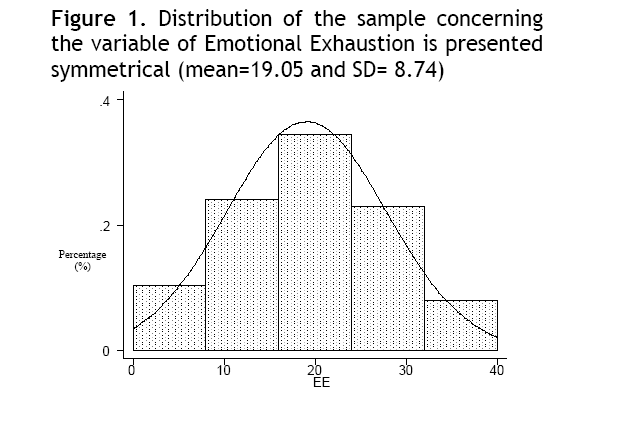
Figure 1: Distribution of the sample concerning the variable of Emotional Exhaustion is presented symmetrical (mean=19.05 and SD= 8.74)
The distribution of the sample concerning the variable of Depersonalization, presents asymmetry since more individuals present low values with mean value x =8.03 and SD=5.06 (Figure 2).
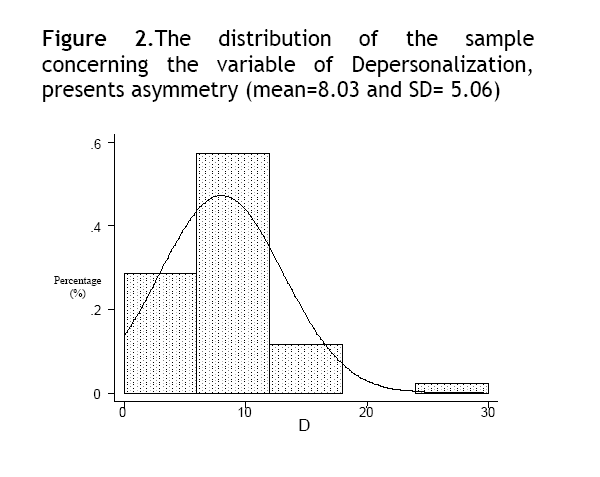
Figure 2: The distribution of the sample concerning the variable of Depersonalization, presents asymmetry (mean=8.03 and SD= 5.06)
The distribution of sample concerning the variable of Personal Accomplishment, presents a relative asymmetry with a mean value x =36.48 and SD=6.54 (Figure 3).
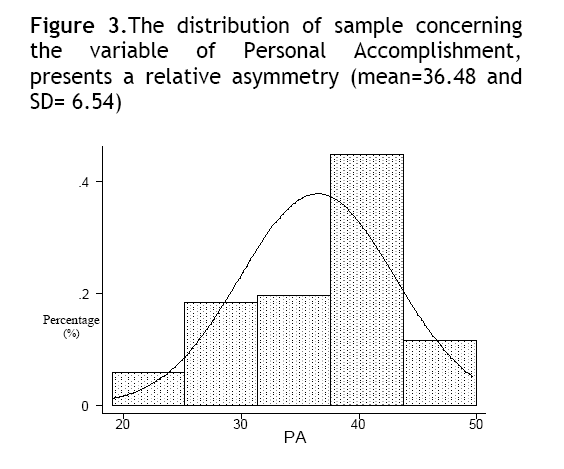
Figure 3: The distribution of sample concerning the variable of Personal Accomplishment, presents a relative asymmetry (mean=36.48 and SD= 6.54)
Using the Pearson cross-correlations test it is realized that:
The Emotional Exhaustion is related positively with the Depersonalization as well as individuals that have high values in Emotional Exhaustion and also have increased values in Depersonalization, while the Personal Accomplishment are related negatively with both, the Emotional Exhaustion and with the Depersonalization.
This is demonstrated in figure 4, in the dissemination.
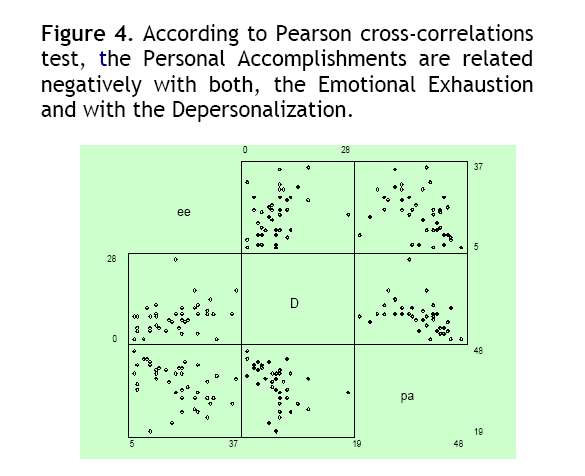
Figure 4: According to Pearson cross-correlations test, the Personal Accomplishments are related negatively with both, the Emotional Exhaustion and with the Depersonalization.
According to the categorization of 22 subjects of MBI for the three factors of Syndrome of Professional burnout regarding the sample we can see:
• Low values in Emotional Exhaustion (63.22%)
• Moderate values in Depersonalization (47.13%) and
• Moderate and high values in Personal Accomplishment (37.93%) – the same value for both scales (Tables 1,2,3)
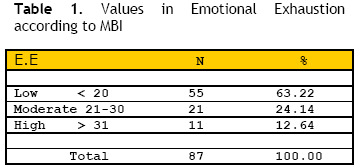
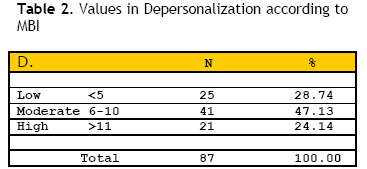
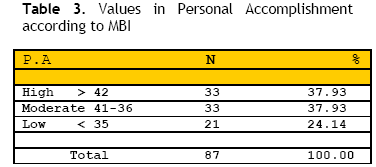
According to the Maslach Burn Out Inventory increased levels of Syndrome of Professional burnout are implied when we have high values in Emotional Exhaustion and Depersonalization and low values in Personal Accomplishment.
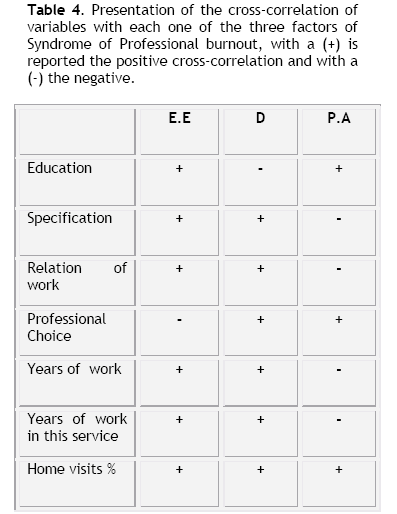
The cross-correlation of variables with each one of the three factors of Syndrome of Professional burnout is represented in table 4. With a (+) is reported the positive cross-correlation and with a (-) the negative.
Regarding the factor of Personal Accomplishment we realize that a percentage of 24.14% of the staff evaluates negatively themselves in relation to the place of work that they possess and an average percentage of 37.93% gives moderate values.
Personal Accomplishment are related positively with the level of education (p=0.01), the fix by fate professional choice (p=0.05) and the percentage of weekly visits in elderly houses (p=0.000). Interest causes the negative cross-correlation of years of work in the service (p=0.34) with Personal Accomplishments.
With regard to the factor of Depersonalization, from the results we see that it is not connected with the level of education (p=0.81). The positive cross-correlation with job relation (p=0.04) causes particular interest. The percentage of visits, that are dedicated represent a mean of 27.3 hours from the 40 weekday hours, almost 2/3 of an individual’s weekly schedule, with a significant positive cross-correlation (p=0.005).
Discussion
The effectiveness of nurse surveillance is influenced by the number of register nurses available to assess patients on an ongoing basis. In our study it is surprising that we found a very small rate of register nurses in this particular health service. This service as a health and social care structure demonstrates the necessity of the application of scientific theory and skills and register Community Nurses are only purely present. With regard to the level of education, the graduates of Medium Professional Schools for Nursing Assistants and the graduates of Technological Educational Institution (register nurses) think that they have not achieved their focus in their job and this means that they are both dissatisfied. This is independent from the education level and it means that both, graduates of primary school and register nurses have the same probabilities of job development. Further, we note that there is not any similar research in Greece and internationally the structure of services has too many differences to compare to.
The positive correlation in relation to work demonstrates a special interest. This can only be explained if it judged with respect to employees in the “help in the home” that have a contract of a specific time period, that is, relation of work with a termination date where the lack of promotion favours indifference and the lack of emotional involvement with the elderly.
The worrying factor is that the total number of years of work has a positive relation with the impersonal behaviour which is demonstrated in the reciprocating table. Specifically, as the number of years of work increase so does the level of impersonal behaviour. Similar results were indicated from other researchers [13,14].
The percentage of visits, that is, a devotion of 27,3 hours from 40 hours of work during the week, approximately 2/3 of their weekly working hours shows a significant positive correlation. This demonstrates the level of load of work in relation to low salary and lack of acknowledgement of work and explains the detainment of workers as the services they offer are not paid accordingly. This has been demonstrated in other research work on professional burnout which has demonstrated that disappointment leads to indifference and the service to elderly is construed as a burden thus blocking emotional involvement with the elderly and substantially leading to the typical fulfilment of one’s obligations with feelings of cynical objection and more times than not acts of aggressiveness [14-17].
The research shows that employees in the “Help-in-the-home” do not demonstrated at present high levels of “Burn out Syndrome”, probably due to the sort time of service development.
But, by examining in part the three components of “professional burn out” it can be demonstrated that the Depersonalization factor has been secured. This is alarming given the established attitude of the employees in “help in the home” in relation to their work for the elderly using the services of “help in the home” and for the function of the specific service. The high percentage of Depersonalization, the indifferent reaction of employees towards the elderly who are in essence the recipients of these services, as it has already been demonstrated up to date by research for the syndrome of “professional burn out”, constitute a critical pre disposure of employees to the syndrome of “professional burn out”. In essence, the tendency of this particular condition increases as the number of years or work increases. The design and implementation of preventative measures is therefore, prerogative on a personal and organizational level [16-20].
Researchers who study the syndrome of “professional burn out” make reference to specific occupations where employees practice a social function [13], specifically, health personnel: doctors, nurses, specifically in cystology [14], psychiatry [15], emergency practice [16], social and educational workers, [17] that is professions that this research is studying.
The emotional and psychological burden that characterizes these professions results in an accelerated expenditure of psychological and physical stored energy resulting in exhaustion [18]. There are multiple reasons for the pathogenesis of this syndrome and the influence of psychological, social, educational and economic factors are a determining factor in the development of this syndrome. The feeling of infulfilment is a result of the decreasing outcome of professional duties and this reflects on the low self esteem due to emotional deprivation and additionally were linking with long term sickness absence from the work [21,22].
The Depersonalization, the third component of the syndrome, constitutes a type of expression that burdens the already encumbering psychological state of the individual who does not express his intense emotions but alternatively expresses himself with emotional withdrawnness, indifference, insulting behavior and cynicism towards people and their own work [21]. It has also been demonstrated that individuals with behavior type A, with an increased need to exercise control, in their work, is expressed as a necessity for survival, competitiveness, provoke ness and an inability to withdraw from one’s duties, and alternatively increase the chances to the symptoms of “burn out” [23]. Some psychiatrists regard the syndrome as a type of depression, even though there is research that supports the correlation between the two components [22,24,25].
The difference is that the syndrome “burn out” influences only one’s professional life [24]. In relation to medical professions, such as untreatable illnesses [25], malignant neoplasm [26] and AIDS [27-28], burdening factors towards the syndrome include a declining social acknowledgement of one’s work, low pay, increased duties, weekly hours of work, lack of support from coworkers and superiors. In relation to the syndrome of “professional burn out” which relate to individuals who care for the elderly, a category which this research has concentrated on, research has demonstrated that there is a greater chance of inflicting the male population [29] as male nurses who care for the elderly in comparison to their female coworkers are inflicted with greater and continuing pressure, show a smaller degree of autonomy within their work place, realize a greater expectation from them and a greater ethical pressure resulting in an increased danger of expressing professional burn out.
Furthermore, a research conducted on 150 care workers, who came from different old age structures throughout France and studied the relation between “burn out” and stress – depression, used 3 questionnaires (the Maslach Burnout Inventory – MBI for “professional burn out”, the STAI for stress and the CES-D for symptoms of depression) showed that a large number, 62 care workers were in the “danger” or “high danger” to develop the syndrome of “professional burn out”, with the age, the profession and the type of service appearing as factors of infliction. A high percentage of infliction was also demonstrated for health professionals in units with elderly patients who suffered Alzheimer’s disease [31]. In some places, in Primary Health Care setting, each internist in the physician-owned Dubuque practice decides how many patients to see each day (the average ranges from 17 to 25) and how many nurses he or she needs (generally, 1.25 to 1.75 full-time equivalents per physician) and pays their salaries out of the earnings he or she generates. The practice has had no difficulty in filling nursing vacancies despite the nursing shortage [30,32,33].
All research efforts in this area are crucial as results can lead to the confrontation of this phenomenon. The encumbrance of “professional burn out” refers not only to professional workers but also to entire organizations. Timely acknowledgement of the problem and the enforcement of measures from professionals and inspectoral units of “help in the home” will result in the psychological health, hygiene and safety of personnel in the “help in the home”.
Conclusions
From the results of this research it is apparent that employees in the “help in the home” do not exhibit at this present time high levels of the syndrome of “professional burn out”, as measurements for the factor of Emotional Exhaustion were low, average for the factor Depersonalization and average for the factor of Personal Achievement. However, the factor of Depersonalization is already consolidated and appears to have a positive correlation with the number of years of work indicating a future danger for the workers in the “help in the home”.
Proposals
The design of preventative measures on a personal and organizational level is imperative. It is also important to reevaluate personal goals and desires of workers in the “help in the home”. Specifically, it is important to acknowledge the confrontations that a professional faces. The identification of these confrontations allows the individual to evaluate which ones have an effective reflection in regulating their emotions and resolving the problems that arise in their work place, and which ones impediment their adjustment thus increasing their stress, their disillusionment and finally the stagnation that one experiences.
The best organizational factor would be in hiring the appropriate professional for the right position, something that is lacking today in the organization of “help in the home”. Furthermore, a clarification is needed in the role, the obligations and participation of the professional in decision making, a factor that increases one’s self control, responsibility and endurance to stressful conditions of work.
The participation in research programs, educational seminars and even bureaucratic responsibilities contribute to the multi variability of one’s work.
References
- Kalino R. “Knowledge jobs ? How to manage without burnout”. Scand J Work Environ Health 1999,25 (6 special issue ): 605-609.
- Papadatou D, Anagnostopoulos F, Monos D. “Factors Contributing to the development of burnout in oncology nursing”, British Journal of Medical Psychological Society, 1994, 67: 187-199, 187.
- Unit “Psichargos” “The burn out syndrome in psychiatric units”. Athens 2005,p. 8 (in Greek).
- Maslach, C. Burnout: the cost of caring. Prentice Hall Inc., New Jersey. 1982.
- Leiter, M., &Maslach, C. Banishing Burnout: Six strategies for improving your relationships with work. San Fransisco: Jossey-Bass, 2005
- Maslach, C, Jackson S. Burnout in organizational settings. Applied Social Psychology Annual, 1984,5: 133-153.
- Rafferty Y, Friend R. & Landsbergis P. “The Association between job skill discretion, decision authority and burnout” in Work & Stress, 2001,Vol 15., No1: 73-85.
- Tsaoussis D, Hatzigiani A, Astrinaki O, Papathanassopoulou D, Georgiadi A, TheodoropoylosCh, Koutsis A. Social and land presuppositions as a connection functioning for KAPI of elderly in the community. Athens 1990. (in Greek)
- Georgoussi E, Ekonomou H, Daniilidou N, Kiriopoulos G. Measurement of the preventative health services for elderly ? KAPI. Public Health in Greece, Themelio, Athens 2002 (in Greek)
- Common Ministerial Decision MD4b/5814 (Low 917, 17.10.1997, Number B) ?Service for home helpι»
- Decition of P4b/.4514, Low 801, 3.9.1996, number B.
- Maslach, C, Jackson, S. E. Maslach Burnout Inventory. Manual 2ed edition. Consulting Psychologists Press 1986, Polo Alto, California.
- Gabassi PG, Cervai S, Rozbowsky P, Semeraro A, Gregori D. Burnout syndrome in the helping professions. Psychol Rep.,2002, 90(1): 309-314.
- Schraub S, Marx E. Burn out syndrome in oncology Bull Cancer 2004 Sep. 91(9): 673-676
- Bombono T, Fava E, Giampieri E, Santinello M. Protection and risk factors with respect to “burn out” of operatives. A comparative study of the psychosocial centers of Milano and Trieste, Minerva Psichiatr, 1990, 31 (4) : 203-207.
- Cevik AA, Holliman CJ, Yanturali S. Emergency physicians and "burn out" syndrome, UlusTravmaAcilCerrahiDerg., 2003, 9(2): 85-89.
- Friedman IA. Burnout in teachers: shattered dreams of impeccable professional performance. J ClinPsychol, 2000, 56(5): 595-606.
- Maslach C, Schaufeli WB, Leiter MP. Job burnout. Annu Rev Psychol, 2001, 52: 397-422.
- Lussier G. Training burnout? flame. Nursing Management Chicago: 2006, 37,4; 14
- Shirey MR. Authentic leaders creating healthy work environments for nursing practice. American Journal of Critical Care, 2006, 15, 3; 256
- Shanafelt TD, Bradley KA, Wipf JE, Back AL. Burnout and self-reported patient care in an internal medicine residency program. Ann Intern Med, 2002, 36(5): 358-67.
- Eriksson UB, Starrin B, Janson S. Long Term Sickens Absence due to Burn-out: Absentes? Experiences. Quality Health Research 2008, 18 (5): 620-632.
- Gorman JM. Caring for the AIDS victim: what can we learn? Am J Psychiatry, 1993, 150(5):689-690.
- Lavanco G. Burnout syndrome and type Abehaviour in nurses and teachers in Sicily. Psychol Rep 1997; 81(2):523-8.
- Iacovides A, Fountoulakis KN, Moysidou C, Ierodiakonou C. Burnout in nursing staff: is there a relationship between depression and burnout? Int J Psychiatry Med 1999., 29(4): 421-33.
- Guntupalli KK, Fromm RE Jr. Burnout in the internist-intensivist. Intensive Care Med.1996, 22(7): 625-30.
- Axelson JA, Clark RH. Burnout Syndrome Among Oncologists. J Clin Oncol, 1992, 10(2): 346.
- Bennett L, Michie P, Kippax S. Quantitative analysis of burnout and its associated factors in AIDS nursing. AIDS Care. 1991; 3(2):181-92.
- Courtial JP, Huteau S. Nurses experiencing burn out in psychiatry: from research to the hospital setting. SantePublique, 2005, 17(3): 385-402.
- Nordam A, Torjuul K, Sorlie V. Ethical challenges in the care of older people nurses. J ClinNurs., 2005, N.14(10): 1248-56.
- Courty B, Bouisson J, Compagnone P. Burn out of formal careers in geriatric facilities. Psychol Neuropsychiatr Vieil., 2004, 2(3): 215-24.
- Mennoia NV, Sacco S, Candura SM. Burn -out risk in health workers at Alzheimer?s units. Ital Med LavErgon., 2000, 22(1): 43-46.
- Okie S. Innovation in Primary Care?Staying One Step. N Engl J Med 359;22 www.nejm.org, 2008.

Open Access Journals
- Aquaculture & Veterinary Science
- Chemistry & Chemical Sciences
- Clinical Sciences
- Engineering
- General Science
- Genetics & Molecular Biology
- Health Care & Nursing
- Immunology & Microbiology
- Materials Science
- Mathematics & Physics
- Medical Sciences
- Neurology & Psychiatry
- Oncology & Cancer Science
- Pharmaceutical Sciences