The knowledge of women in a greek province regarding the cervical cancer, its prevention capabilities and the pap test
Gesouli-Voltyraki Eftyhia
1Assistant Professor, Nursing Department, TEI of Lamia
2MD, National Health System, Registrar, Health Center of Aliartos
3RN, Nursing Department, TEI of Lamia
4Associate Professor, Nursing Department, TEI of Lamia
- *Corresponding Author:
- Gesouli E
RN, Iroon Politechniou 38
PC 15773 Zografou Athens
Tel: 210 7792366
E-mail:egesouli@teilam.gr
Abstract
Purpose : The purpose of the present study was to explore the knowledge of women in a Greek Province regarding cervical cancer, its prevention capabilities and the Pap test. Method and material : Τhe sample-studied consisted of 100 adult women attended in outpatient settings. The data were collected by the completion of a questionnaire referring to the knowledge of the women regarding the prevention of the cervical cancer, and the Pap test. Statistical analysis was conducted using the Statistical Package for Social Sciences 13.0 and the methods used were X2 test along with Yates’ correction for 2x2 tables. Results : 81% of the participants belonged to the group of 20-45 years old. Regarding the demographic characteristics, 53% of the sample-studied were High School graduates, 59.2% were not employed, and 71% lived in urban areas. Regarding the perception of women towards the disease, 63.2% considered it common, 17.3% very common, whereas 19.4% responded it was rare or very rare. 64.3% of the participants reported the doctor as the main source of information, 15.3% the family and 20.4% reported other sources of information. Regarding the frequency of having the Pap test, 79% had conducted it at least once in their life. 71.3% had the test in the last 1-3 years, whereas 28.7% within the last year. In regard to the precise knowledge for the purpose of the test, 23.6% reported the prevention of the cancer, 19.1% the prevention of the cancer of the genitals, 55.1% the cervical cancer and 2.2% reported other reasons. Single women knew to a smaller extent what the Pap test was compared to married, divorced or widowed with statistical significant difference, p= 0.000. Regarding the place of residence, women living in urban area knew better what the test was, with statistical significant difference compared to the village residents, p=0.000. In terms of the causes for not having conducted the test, 40% reported negligence, 25% lack of information and 35% reported other reasons as the main causes for not having the test. Conclusions : Even though there is a satisfactory level regarding general knowledge, the more specialized knowledge is rather fragmentary. Socioeconomic factor s play important role in taking the Pap test.
Keywords
Cervical cancer, Pap test , screening , Knowledge, women
Introduction
The cervical cancer is a significant health issue worldwide. It is the second most common cancer worldwide in women under 45 years of age, whereas it also affects a significant number of women over that age. It is estimated that approximately 40 women die every day of infiltrative cervical cancer [1].
According to the literature, during the last years, both in Greece and in other developed countries there has been a remarkable decrease in the frequency of occurrence of cervical cancer, mainly attributed to the precautionary medical examinations [2]. The lack of information and negligence are significant reasons for failure of the pre-symptomatic testing procedures (screening tests), as they lead less and less women to do the test [3,4].
The demographic and socioeconomic factors play an important role in the participation in the screening tests [5,6]. The phenomenon is worldwide, concerning both the developed, as well as the developing countries and illustrates the social inequalities, the limited access some social groups have to health services, and also the limited sensitization the people themselves have regarding their health issues. The recording of the shortages in the information that concern women and the review of their opinions on the matter of the cervix is expected to help the implementation of more effective prevention programs [7-9].
This study is part of a wider research and the purpose was to assess the knowledge the women in a Greek province have, in regard to the prevention capabilities of the cervical cancer, the Pap test, the frequency it should be conducted and the existence of an HPV vaccine. The receptiveness to vaccination matters in regards to HPV, both for themselves, and their children was also assessed. This study reports the results in regard to the Pap test.
Purpose
The purpose of the present study was to explore the knowledge of women in a Greek Province regarding cervical cancer, its prevention capabilities and the Pap test.
Method and material
The present study included 100 adult women aged 18-65 years old.
The tool of this research was a questionnaire which included 66 closed-type questions and referred to the knowledge the women have regarding the prevention of the cervical cancer, the Pap test, the HPV virus, as well as their attitude to vaccinating themselves and their children. Every woman gave in written her consent for the participation in the research and filled in anonymously the questionnaire, in the presence of some members of the research group.The study was conducted during the period September-November 2008 in the outpatients’ department of the General Hospital of Lamia, the Health Center of Koropi and the City Hall of Sofiko Korinthias, all towns of central and southern Greece.
Statistical analysis
a. Coding: Demographic information was acquired in regard to the place of residence, the family income and the family status. The socioeconomic status was evaluated based on the education and the occupation. The academic education was defined on 4 levels (Elementary-Junior High School-High School-University). Derivative variables were created, by counterbalancing various groups, as properly.
b. Process: Initially, descriptive statistics was applied and contingency tables were created on the general epidemiological characteristics of the sample. X2 test along with Yates’ correction for 2x2 tables was used. Significance was now considered at 0.05 level.The statistical process was conducted with SPSS for Windows, Version 13.0.
Results
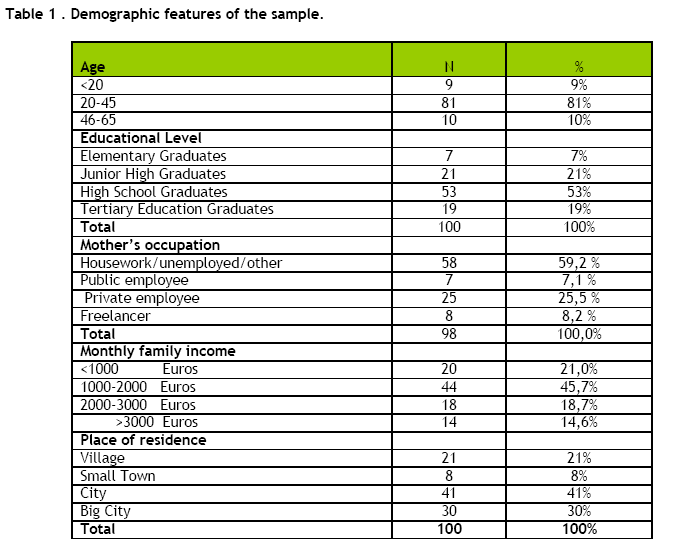
81% of the participants belonged to the group of 20-45 years old. Regarding educational status, 53% of the women were High School graduates, 19% were tertiary education graduates (University-Technical College) and 28% had completed basic education. In regard to occupational status, 59.2% of the women were not employed, whereas 25.5% were employed in the private sector and 17% were unemployed. In terms of financial status, 45.7% of the women reported a family income from 1000 to 2,000 Euros and 21.0% <1000 Euros. In regard to place of residence, 71% lived in urban areas. (Table 1).
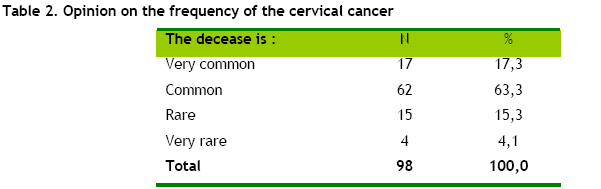
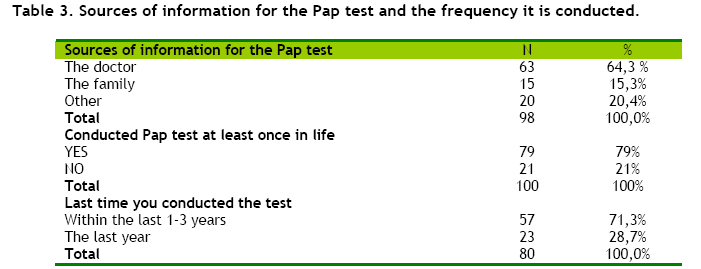
Regarding the perception of women towards the disease, 63.2% considering it common, 17.3% very common, whereas 19.4% responded it was rare or very rare (Table 2). 64.3% of the participants reported the doctor as the main source of information, 15.3% the family and 20.4% reported other sources of information. Regarding the frequency of having the Pap test, 79% had conducted it at least once in their life. 71.3% had done the test in the last 1-3 years, whereas 28.7% within the last year (Table 3).
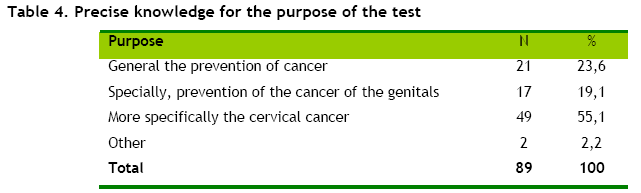
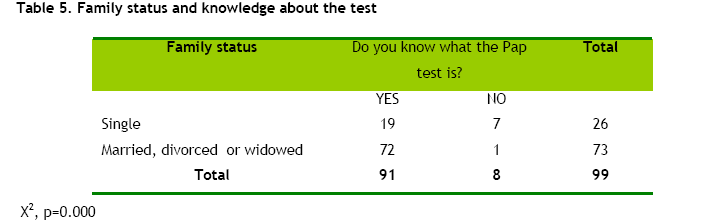
In regard to the knowledge of the Pap test, 55.1% of the women knew exactly why the test was conducted. As for the precise knowledge for the purpose of the test, 23.6% reported the prevention of the cancer, 19.1% the prevention of the cancer of the genitals, 55.1% the cervical cancer and 2.2% reported other reasons. (Table 4).Single women knew to a smaller extent what the Pap test was with a significant statistical difference compared to married, divorced or widowed, p= 0.000.
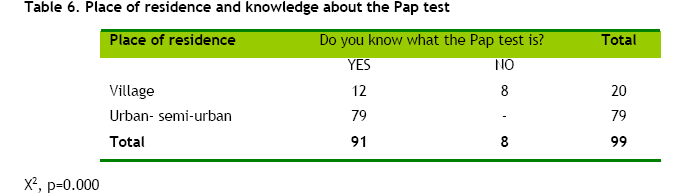
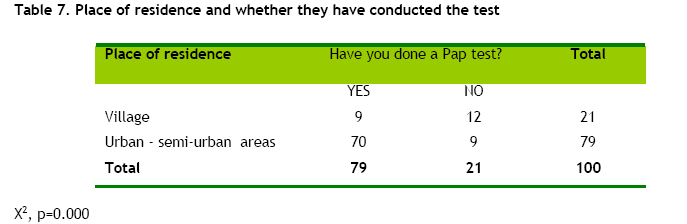
Regarding the place of residence, women living in urban area knew better what the test was, with a statistical significant difference compared to the village residents, p=0.000. (Tables 5, 6, 7).
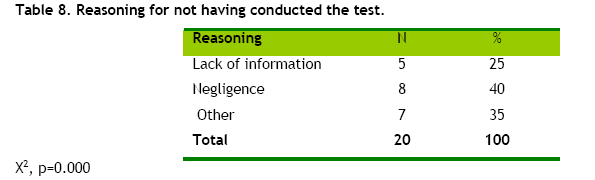
In terms of the causes for not having conducted the test, 40% reported negligence, 25% lack of information and 35% reported other reasons as the main causes for not having the test (Table 8).
Discussion
The cervical cancer still remains one of the most common types of cancer worldwide, with a great mortality rate [10]. That conviction seems to be established in Greek women, since the majority of the women in the sample responded that it was a common decease, estimating the number of deaths in Europe because of it to 10-50 daily.
In Europe, the incidence of cervical cancer is very high as it is the second most commonly presented cancer in young women of age 15-44 years old1. Approximately 35,000 women in Europe are diagnosed with cervical cancer every year and 15,000 women die yearly from this decease. This amounts with more than 40 women in Europe dying daily of cervical cancer [1,11]. In regard to the mortality rates from cervical cancer in other European countries, the highest rates are observed in the Eastern European countries (e.g. in Romania 10.6/100,000 in the age 20-44) and the lowest in Finland (0.5/100,000) [12].
The screening test can lead to a decrease of the incidence of cervical cancer. Indeed, this has partly happened both in Greece and in other developed countries during the last 10 years [2]. According to the results of the present study, most women knew the precautionary value of the Pap test, which is the cornerstone of the secondary prevention of the decease. On the contrary, 20% of the participants reported ignorance regarding the ability of the test to prevent cervical cancer. However, it is noted that on a national level, organized programs for the massive screening test of the population using the Pap test (e.g. in Scandinavia, the Great Britain) have a chance to succeed in regard to the cervical cancer (Such a program does not exist in Greece). The extent of the mass population checks varies depending on the country. For example, in England, 83% of the women of age 25-64 years old are checked in recommended interims in comparison to 53-74% of the women in Italy age 25-64 years old [13].
The defective updating/informing and the fragmentary knowledge are encountered on a worldwide level, whereas the negligence is revealed as a basic cause for not conducting the examination. In a research in Chili, which was conducted in women aged 25-54 years old in the outpatients’ department of the hospitals, only 28% were found to know that Pap test was conducted in order to detect neoplasia, whereas most women knew it had something to do with the genitals, 14% didn’t know anything about it, while 34% attributed to negligence the fact that they didn’t do the test, whereas 27% reported that they didn’t feel the check every 3 years was necessary [14].
In another research conducted by Andreasen et al., [15] in Denmark, it was found that the majority of the women (90%), regardless of age and education, had a relatively satisfactory knowledge about the exam. They knew that the smear was received from the cervix and that the early diagnosis was very important, and also that cervical cancer is curable. Other more specialized knowledge, such as to recognize the shape of the cervix, was limited. Finally, the majority of the sample-studied believed that the test should be conducted more often [15]. In a study that compared the knowledge of women in Greece and Finland in regard to the Pap test, it was found that even though the general level of knowledge was similar (<50%), the level of knowledge of the women in Finland was significantly higher [16]. In the countries of the so called Third World, the picture seems to be worse, even among University students. In a respective study, which was conducted in Nigeria, it was found that 2/3 of the students (60% of whom were sexually active) didn’t know the purpose of the test, whereas none of the 220 people in the study had done the examination [17].
In the present study, the percentages of the women in their total, appeared significantly improved, but indeed, in younger women, there seemed to be an information issue, since half the women under 20, and 1/3 of the women in the age 20-24 didn’t know the purpose of the test. Living in a rural area and unemployment were related to defective knowledge. Another research, conducted by Paraskevopoulou et al., [18] in Greece, also found that 25% of the women (average age of the sample was 42 years old) had never done a Pap test in their life.
The single women also came behind in the matter of information. 40% responded that negligence was the most important reason that they hadn’t done the test. According to the results of the present study, the lack of information and negligence were the most important reasons for the failure to do the pre-symptomatic check [3,19,20].
Demographic and socioeconomic factors significantly account for the low rates of participation in the screening test. Studies conducted in various countries, such as the USA, Canada, Taiwan, as well as Latin America pinpoint the role of the social inequalities in the matter of prevention [4,5,21]. A recent, large study, which was conducted in the larger cities of the USA, showed that not only low family income (< $15,000) but also the relatively low level of education (Junior High School graduates) came together with lower percentages of women conducting the Pap test (approximately 75% to 92%) [7]. A research in Taiwan revealed that even when there is free access to screening programs (that study was in regard to cervical and breast cancer), the participation of people with low socioeconomic level was limited [9]. Racial factors, as well as the age were correlated with the decreased rates of women conducting the test. Immigrants and African American women showed the lowest participation rates, as well as elder women [6,8]. The test participation rates were lower in rural areas, even in developed countries, according to a recent research in Austria [22]. Similar findings are reported by a study in Spain, with the rates ranging around 66% for rural areas and elder women [23]. We should mention that single women, with a low income, who belong to minority populations, present high percentages of frequent presence of HPV [24]. Therefore, it is concluded that the rates of the women who conducted the test are lower in those groups that should be the main target of the prevention programs, thus stating the necessity for more efficient interventions.
Regarding the limitations of the present study, the relatively small size of the sample, as well as the fact that the ethnicity/place of origin of the women was not asked. However, the fact that the findings were consistent with those of international studies with larger samples reveals the extent of the issue and pinpoints the need for more efficient interventions, especially on the more susceptible population groups.
Conclusion
In conclusion, even though there is a satisfactory level regarding general knowledge, the more specialized knowledge, for example, the precise purpose of the test, is rather fragmentary. The women do not seem to have fully understood basic knowledge around the cervical cancer prevention. The updating/informing of women by the health professionals should include the entire age spectrum, as well as women of every socioeconomic status, especially from the weaker economic groups. The women in rural areas, the unemployed and the single women come behind in the matter of the right information, and also the regular check. Further research are expected to reveal clearly the specific characteristics of those social groups, who should be a priority for the massive screening test programs.
Bibliography
- Ferlay J., Bray F., Pisani P., Parkin DM. GLOBOCAN 2002. Cancer Incidence, Mortality and Prevalence Worldwide. IARC Cancer Base No. 5 Version 2.0. Lyon, France: IARCPress; 2004.
- Kiriakogianni-Psaropoulou P., Zarogianni Ch., Markidou S., Poulianou E., Kirkou K., Koutselini E., et al. Screening for on time diagnosis of the cervical cancer in Greece (Ilea-Messenia) MEDICINE.1998;74(3):236-241.
- Davim RM., Torres GV., da Silva RA., da Silva DA. Knowledge of women about the Pap test in a basic health unit in Natal/RN, Brazil. Rev Esc Enferm USP. 2005 ;39(3):296-302.
- McDonald JT., Kennedy S. Cervical cancer screening by immigrant and minority women in Canada. J Immigr Minor Health.2007;9(4):323-34.
- Reyes-Ortiz CA., Camacho ME., Amador LF., Velez LF., Ottenbacher KJ., Markides KS. The impact of education and literacy levels on cancer screening among older Latin American and Caribbean adults. Cancer Control.2007;14(4):388-95.
- Peterson NB., Murff HJ., Cui Y., Hargreaves M., Fowke JH. Papanicolaou testing among women in the southern United States. J Womens Health (Larchmt).2008;17(6):939-46.
- Coughlin SS., King J., Richards TB., Ekwueme DU. Cervical cancer screening among women in metropolitan areas of the United States by individual-level and area-based measures of socioeconomic status, 2000 to 2002. Cancer Epidemiol Biomarkers Prev.2006;15(11):2154-9.
- Segnan N. Socioeconomic status and cancer screening. IARC Sci Publ. 1997;(138):369-76.
- Lin SJ. Factors influencing the uptake of screening services for breast and cervical cancer in Taiwan. J R Soc Health. 2008;128(6):327-34.
- Davies P., Bogdanovic-Guillion A., Grce M., Sancho-Garnier H. The future of cervical cancer prevention in Europe. Coll Antropol.2007; 31 Suppl 2:11-6.
- Levi F., Lucchini F., Negri E., Franceschi S., la Vecchia C. Cervical cancer mortality in young women in Europe: patterns and trends. Eur J Cancer. 2000;36(17):2266-71.
- Arbyn M., Raifu AO., Autier P., Ferlay J. Burden of cervical cancer in Europe: estimates for 2004. Ann Oncol. 2007;18(10):1708-15.
- Anttila A., Ronco G., Clifford G., Bray F., Hakama M., Arbyn M., et al. Cervical cancer screening programmes and policies in 18 European countries. Br J Cancer. 2004;91(5):935-41.
- Lamadrid A S. Knowledge and fears among Chilean women with regard to the Papanicolaou test. Bull Pan Am Health Organ.1996;30(4):354-6.
- Andreasen LJ., H?lund B., Jeune B., S?rensen B. Screening against cervical cancer. Experiences, attitudes and knowledge of women in the county of Funen. Ugeskr Laeger.1998;160(4):405-9.
- Iatrakis G., Zervoudis S., Peitsidis P., Nikolaki MM., Biba D., Sotiropoulou E. Knowledge and general consideration about Pap test screening among women from Finland and Greece.Clin Exp Obstet Gynecol. 2008;35(3):211-4.
- Akujobi CN., Ikechebelu JI., Onunkwo I., Onyiaorah IV. Knowledge, attitude and practice of screening for cervical cancer among female students of a tertiary institution in South Eastern Nigeria. Niger J Clin Pract.2008;11(3):216-9.
- Paraskevopoulou E., Economou A., Panagopoulos P., Zikopoulos M., Petrakos G., Koutras I. Cervix cancer scree.ning among Greek and immigrant women: the experience of a Greek District Hospital. Clin Exp Obstet Gynecol. 2005;32(1):52-4.
- Duffett-Leger LA., Letourneau NL., Croll JC. Cervical cancer screening practices among university women. 2008;37(5):572-81.
- Reid J. Women's knowledge of Pap smears, risk factors for cervical cancer, and cervical cancer. J Obstet Gynecol Neonatal Nurs. 2001;30(3):299-305.
- Woltman KJ., Newbold KB. Immigrant women and cervical cancer screening uptake: a multilevel analysis. Can J Public Health.2007;98(6):470-5.
- Haidinger G., Waldhoer T., Vutuc C. Self-reported Pap smear screening in Austria. Wien Med Wochenschr. 2008;158(7-8):222-6.
- Puig-Tintor? LM., Castellsagu? X., Torn? A., de Sanjos? S., Cort?s J., Roura E., et al. Coverage and factors associated with cervical cancer screening: results from the AFRODITA study: a population-based survey in Spain. J Low Genit Tract Dis. 2008;12(2):82-9.
- Kahn JA., Lan D., Kahn RS. Sociodemographic factors associated with high-risk human papillomavirus infection. Obstet Gynecol. 2007;110(1):87-95.

Open Access Journals
- Aquaculture & Veterinary Science
- Chemistry & Chemical Sciences
- Clinical Sciences
- Engineering
- General Science
- Genetics & Molecular Biology
- Health Care & Nursing
- Immunology & Microbiology
- Materials Science
- Mathematics & Physics
- Medical Sciences
- Neurology & Psychiatry
- Oncology & Cancer Science
- Pharmaceutical Sciences